
What has the AML Pro got in common with a Ouija board?
The twenty feet it is sold on does not survive contact with the physics, and that part has been settled for a while. The harder question is the one I get asked on every course: then why do the demonstration videos look so convincing? The answer is not in my opinion. It is in the manufacturer’s own patent and their own operating instructions.
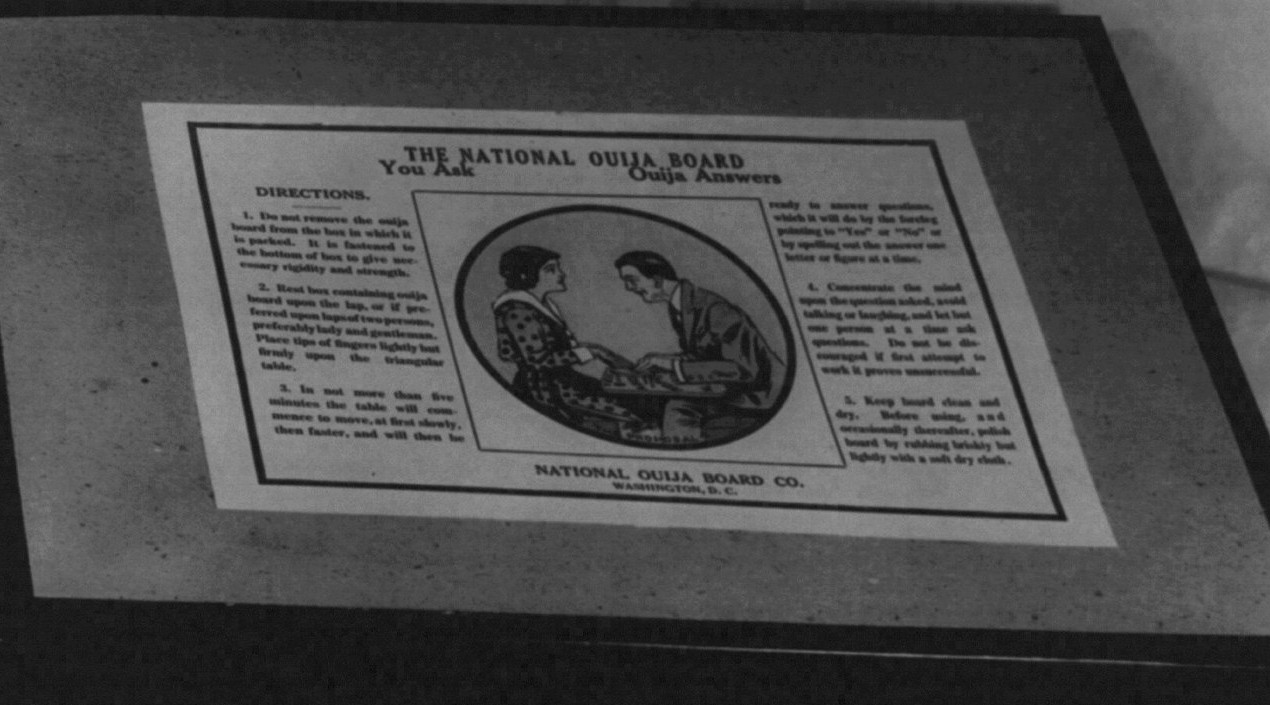
A Ouija board works. Nobody disputes that the planchette moves. What is in dispute is what moves it.
That is the whole of this page. The AML Pro has real electronics inside it, and its lights really do come on. The question is what turns them on, and whether the person holding it can tell the difference.
1Start with the settled part
The physics is done. Four lines and a link.
- The frequency is wrong for the job. Ground radar built for utility depths settles between roughly 200 MHz and 1,500 MHz, because higher frequency buys resolution and loses depth. Multi-gigahertz radar exists, but for shallow work like scanning concrete. The AML Pro transmits at 2.45 GHz and is sold for twenty feet.
- 2.45 GHz is the microwave oven band. Not because it is the frequency water absorbs hardest, which is far higher at around 20 GHz, but because it is absorbed just enough to heat food while still reaching a few centimetres in. Wet ground is lossy at it for the same reason, and wet ground is the condition the device is advertised for.
- The power is small and the losses are not. Their own certification laboratory’s reading works out at about 41 mW. On its own that means little. Going down through metres of wet ground and back, at a frequency that ground eats, it means a lot. The full working is here.
- Fourteen years, and no blinded test I can find. The one peer-reviewed paper I have found is Lee and Yun 2025. Single operator, the authors’ own testbed, over pipe whose positions were already known.
The physics case is made in full in the long investigation. This page assumes it and moves on.
2So why does anyone believe it?
Watch one of the videos and something does happen. Something moves. Two lights come on. Whoever is holding it is not lying about that, and the people who send me the clips are not stupid.
The effect has a name and it is over a century old. The ideomotor effect is a small, genuine muscular movement produced by expectation, below the level at which the person notices making it. It is the accepted explanation for the Ouija planchette and for dowsing rods.
An expectation of where the answer should be. A freedom of movement fine enough that small corrections go unnoticed by the person making them. And no feedback that can contradict them.
Their own manual supplies all three. Start with expectation. This is what it says about when the AML is most useful. I have added no emphasis, this is how it is printed.

The recommended use is a utility the operator already knows is there. That is the first condition, supplied in writing by the people who built it.
3What their own patent says about the lights
The patent is US 7,898,456, filed by Paul Cloutier and Delbert Oehme in 2009 and later held by SubSurface Instruments. It describes a real electronic instrument: a transmitter, pairs of receive antennas, and phase detectors comparing what comes back.
Two sentences in it matter more than anything in the marketing.
“With the microwave radiation used in the preferred embodiment, the measured phase difference can vary rapidly with slight movements of the apparatus.”US 7,898,456, description
“The output of each phase detector is a very sharp ‘peak’ condition, and any change in phase difference between associated receive antennas will move the phase detector output away from the 0.2 volt level.”US 7,898,456, description
That is them telling the patent office the lights jump when the unit moves a little.
So there is a real electronic reason the lights change when your hand moves. That does not mean a buried pipe caused it. Those are two different things, and the rest of this page is about the gap between them.
4Every instruction they give is about your hand
This is the latest manual, V4301, dated January 2025. Hold the handle parallel to the ground at waist level, at least eighteen inches in front of your body. Sweep it in a slow back and forth W. The blade sits at three prescribed angles.
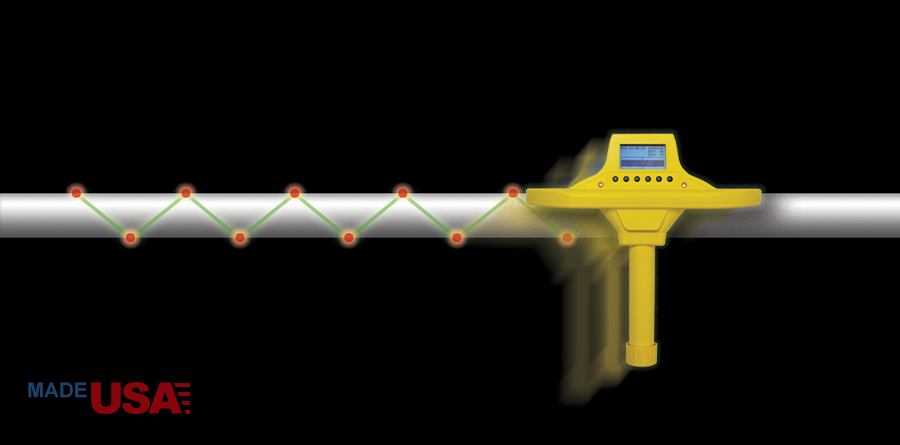
Nothing in the patent asks for a W. It says the operator walks toward the target with the blade tilted down, and that is the only guidance it gives on how to move it. The word appears once in the whole latest manual, page 19, with no reason given. I read all 32 pages looking for one.
What a W does give you is a lot of small, quick changes of direction. Your hand is constantly reversing. By their own FAQ below, the lights change state every couple of inches of that movement. So the sweep they teach guarantees the indicator is never still, and you are left deciding which flicker was the pipe.
| Stage | Angle | What the manual instructs |
|---|---|---|
| Searching | 10° | Blade projects 10° outward, handle parallel to the ground, 18 inches in front of the body, swept in a back and forth W. |
| Locating | 0° | Once something is found, pivot the handle upward until the screen reads 0° and the blade sits over the signal. |
| Depth | 45° | Tilt the handle down to 45° and walk backwards until you detect the top of the pipe again. |
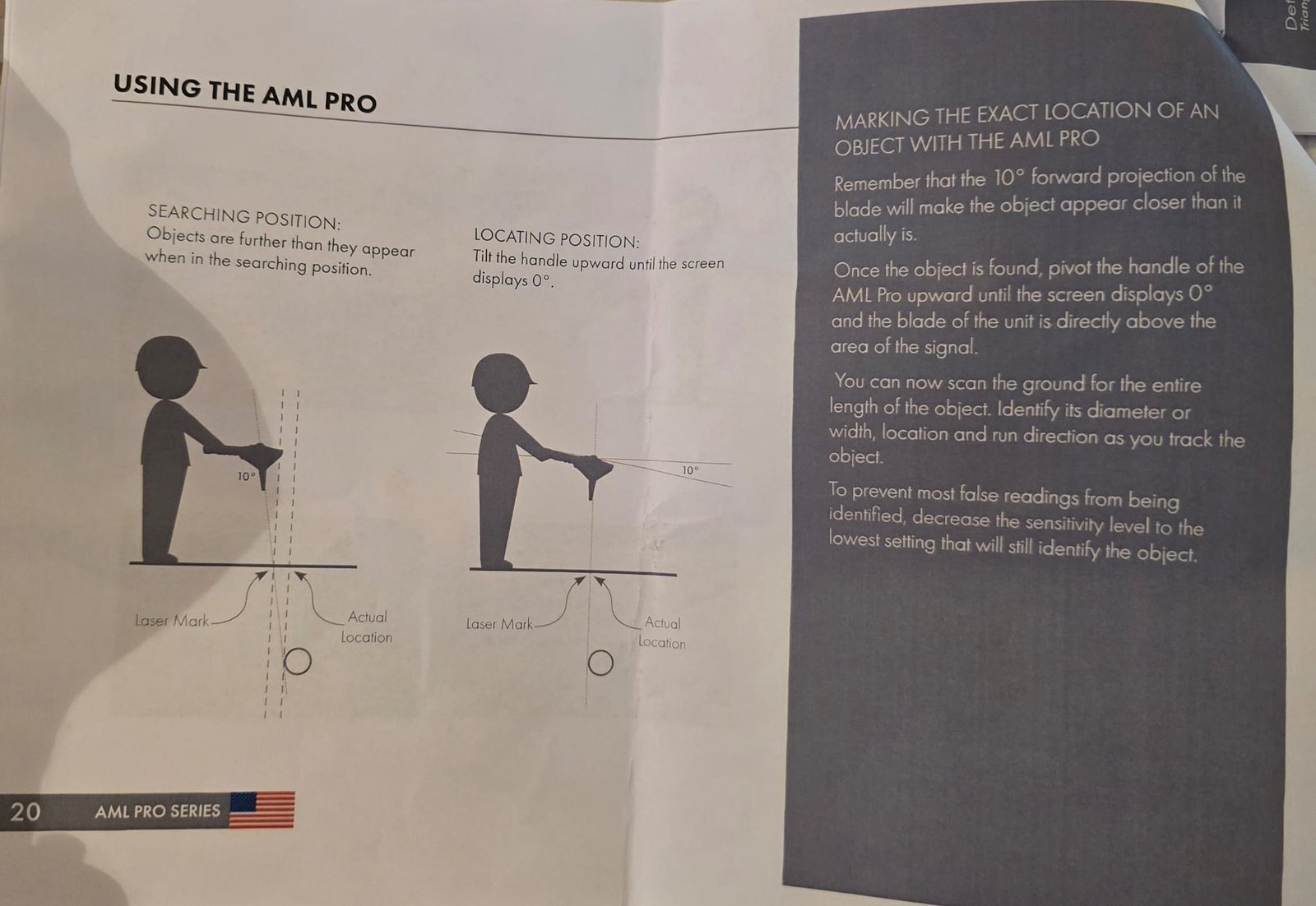
Three taught hand positions, at arm’s length, swept side to side. Now their published FAQ, on what the lights do while you do that:
“Both lights will come on then go off approximately every 2 inches when the antennas are located inside of these null zones.”
At 2.45 GHz the free space wavelength is 12.24 cm. Half of that is 6.1 cm, or 2.4 inches. The interval they publish is the half wavelength of their own carrier, which is what a phase-comparison instrument does: move the antenna half a wavelength and the phase relationship goes through a full cycle.
That spacing is set by the wavelength and by nothing else. It would look exactly the same whether the thing sending signal back is a pipe, the ground surface, a kerb, or the operator. So the flicker tells you the device is reacting to something a few centimetres nearer or further away. It cannot tell you which of those it was, and neither can the person holding it.
Then there is the operator. Three lines from two manuals, one printed while the patents were still pending and one revised in January 2025, all saying the same thing.
“When detecting, move the unit, not your feet.”First two: Patents Pending edition, page 10. Third: V4301 page 19, the latest manual.
“being careful not to get too close to your feet, or you’ll ‘locate’ them, as well.”
“The blade face of the unit is designed with a 10° degree outward projection to eliminate interference with the operator’s feet.”
So the operator’s own boots move the indicator, and there is a fixed angle in the blade to keep them out of it. On their own account the reading depends on where the person is standing as well as where the unit is pointing.
Which cuts both ways. The thing responds to whatever is near it, and the nearest thing is the bloke holding it.
And then the instruction that finished this off for me, from the manual printed while the patents were still pending.
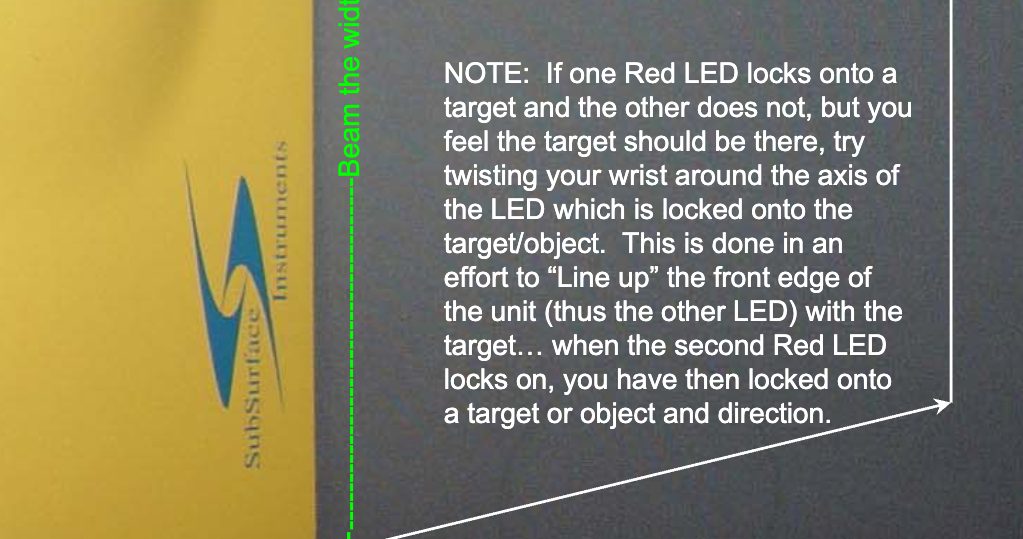
Look at what that tells you to do. The device has given you one light. You reckon there is a pipe. So you move your hand until the second light agrees with you.
There might well be a real electronic reason twisting changes the reading, and I am not disputing that. What I am disputing is being told to do it at the exact moment you have already decided the pipe is there.
5So what would settle it
Somebody buries a length of plastic pipe in ground the operator has never seen. The operator is not told whether anything is buried at all. They mark where they say it runs. Then it is dug. Repeat it enough times that luck cannot explain the score.
Nothing like that has been published in fourteen years. What gets sent to me instead are demonstration videos, and the question to ask of the next one is always the same: did they already know where that pipe was? Tracing a trench line on ground that was dug and reinstated. Walking between two visible valve boxes. Following a route already marked on the surface. A pipe on the demonstrator’s own plot, buried by the demonstrator.
None of those tests the device. Every one supplies the answer before the walk starts, which is exactly the use the old manual recommends.
6The line they took out
The wrist-twisting instruction is not in the latest manual. We hold five editions: the pre-2011 Patents Pending manual, the 2014 multi-language manual, the 2015 revision, V4.29 of February 2021, and V4301, dated January 2025, which the manufacturer has since taken off its website. “Twist your wrist”, “somewhere over here” and “you just have to know, or figure out, what you are on” appear in the first, and in none of the other four.
At some point somebody took out the line that told the operator to adjust the unit until it agreed with them.
I am not going to tell you why. I am going to tell you it was in there, that it is not any more, and that both manuals are a few clicks apart if you want to put them side by side.
And the decision being made with this thing is where to put a digger. That is the reason I keep writing about it rather than letting it go.
The long investigation has the physics, the patent record and the industry context in full. The five minute version is the one to send somebody who is about to buy one. The power figure covers the specification that has never been published. The index has every claim and all five pieces on one page.