
The power figure that is not in the instructions
Anything sold in Great Britain that deliberately transmits radio has to state which frequencies it uses and how much power it puts out, in the instructions that come with it. The AML Pro states the frequency. The English instructions stop there. I worked the power out myself from their own certification file, and it comes to about 41 milliwatts.
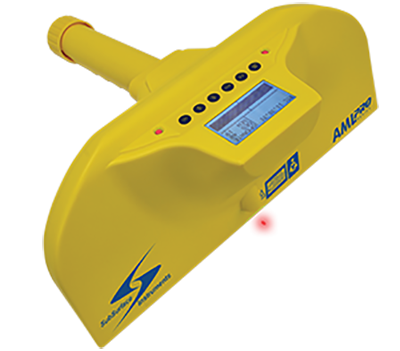
Anything that deliberately transmits radio and is sold in Great Britain has to be accompanied by instructions stating the frequency band and the maximum radio-frequency power. Regulation 13(2)(b). The AML Pro’s English instructions give the frequency, 2.45 GHz, and stop there.
It is, however, one line of arithmetic away inside their own FCC test report: about 41 milliwatts radiated, forty one thousandths of a single watt. That figure is mine, worked from their laboratory’s own measurement, and section 7 shows the working.
There is also a power figure in their own paperwork, once: Leistung: 10 mW, on the German page of their 2014 manual and on no other language page in it. I would not build an argument on that line and section 6 explains why, but it is a strange thing to find.
That is the device being sold on finding plastic pipe at twenty feet, through clay, wet soil and standing water, and the decision people make with it is where to put a digger.
1Six things make a radio device legal to sell in Great Britain
If a device deliberately transmits radio and it is placed on the market in Great Britain, the Radio Equipment Regulations 2017 (S.I. 2017/1206) require six things. None of them are obscure. Every radio product you own has been through this.
- A conformity marking on the equipment or its data plate, and on the packaging. Regulation 44.
- A declaration of conformity, or a simplified one with a web address for the full text, accompanying every single unit. Regulations 13(3) and 43.
- Technical documentation drawn up and kept for ten years. Regulations 9 and 11.
- Instructions stating the frequency band and the maximum radio-frequency power transmitted. Regulation 13(2).
- The manufacturer’s name and a postal address. Regulation 12.
- The importer’s name and postal address, where there is one. Regulation 23. The regulations define an importer as a business established in the United Kingdom, so a seller shipping in from outside it is not one.
Five of those have to be with the product or on it. The sixth, the technical documentation, has to exist, be kept for ten years, and be produced if an enforcing authority asks for it. I am working through all six. This article is about the fourth one, and specifically the second half of it.
“the maximum radio-frequency power transmitted in the frequency band or bands in which the radio equipment operates”
2.45 GHz is on the website, in the brochure, in the manual and in the data sheet. The power I cannot find at all.
2Whose job is it to put the figure there?
Before anyone says that is the American manufacturer’s problem, it is not only. The duty to supply the figure is the manufacturer’s wherever they are, and selling direct from outside the United Kingdom does not shed it. Contracting to sell a finished product to a buyer in Great Britain is placing it on the Great Britain market.
And whoever sells it here carries a duty of their own. It is not a vague one, and it is not left to inference. It names the regulation this article is about.
“Before making radio equipment available on the market, the distributor must verify that … the manufacturer has complied with the requirements set out in … regulation 13 (instructions and information to be included with the radio equipment)”
That is a check to be made before the thing is sold, not a question to be answered afterwards. Not taken on trust from a supplier three thousand miles away. And where the equipment does reach Great Britain through a United Kingdom business, regulation 23 puts that importer’s name and address on it as well.
3Six documents, and every page of their website
The latest operator’s manual, thirty two pages. The previous revision of that manual. The manufacturer’s brochure. The AML Pro data sheet. The product guide the GB and Ireland seller hands to customers. The twelve page company catalogue. And the manufacturer’s own website, all four hundred and eighty one pages of it.
| Where I looked | Maximum RF power stated? |
|---|---|
| Operator's manual, latest revision (32 pages) | No |
| Operator's manual, previous revision | No |
| The manufacturer's brochure | No |
| The AML Pro data sheet | No |
| Product guide, GB and Ireland seller | No |
| Company catalogue (12 pages) | No |
| The manufacturer's website (481 pages) | No |
Six of those seven go to customers. The frequency is in most of them. The maximum radio-frequency power is in none of them.
What they say instead
This is the page in the latest manual that explains what the device does. The whole claim is on it, and so is the word they use in place of a number.

The sales brochure describes the transmitter the same way.

It is not reserved for the radio either. In the same brochure the word does duty for the battery compartment and for the USB socket.


So I counted. Five documents from the manufacturer and its GB and Ireland seller, one hundred and fourteen pages between them, searched for the word and for the number.
| Across 114 pages of their literature | Times it appears |
|---|---|
| “Power” and its variants | 74 |
| of which “powerful”, the adjective | 13 |
| batteries, power switches, indicator LEDs, the USB port | 61 |
| A maximum radio-frequency power, in watts or milliwatts | 0 |
Sixty one of those seventy four are the battery, the power switch, the green indicator light or the USB socket. The other thirteen are the word “powerful”. Not one is a figure.
That figure, worked out from their own certification file in section 7 below, is about 41 milliwatts.
They print it for their other locators
It is not as though they are unfamiliar with the idea. Turn to page five of the same twelve page guide and their cable locators get a number in the opening line. The PL-VF3 has “a 3W power output”. The PL-VF10 is “equipped with a powerful 10W transmitter and optional 1/2 and 1/4 power outputs”.
Two pages earlier the AML Pro gets fourteen bullet points. Housing weight, sensitivity settings, headphones, battery, USB port, back-lit display, GPS, levelling meter, warranty. Not one of them is a power. If SSI have published it somewhere I have not looked, show me and I will add it to this article the same day.
4Go and look in your case
That is everywhere I can reach from the outside. Regulation 13 is about information that accompanies the equipment, so what matters now is what came in your box, not what is on a website. The figure to look for is a maximum RF power, in milliwatts, in dBm or as an e.i.r.p. Worth checking the rest while you are in there: a declaration of conformity, a conformity marking on the unit and on the case, the manufacturer’s postal address, and the name and address of whoever imported it.
The figure is in none of the current English material I have found, so if it reaches a British buyer at all it reaches them in the case, with the product.
If it is not in there, this device does not carry what the law requires for it to be sold here.
5Then I asked a distributor, as a buyer
In August 2026 I wrote to one of their distributors as what I am, a leak detection company looking at the device for plastic pipe. Among four questions:
“Can you send me the full technical specification. We work in volcanic soil here, which is dense and often wet near pools, so I would like to see the operating frequency and the transmit power before I judge whether it stands a chance in our conditions.”My enquiry, 22 August 2026
The reply was prompt and helpful, with a formal quotation and a datasheet attached. It answered the frequency, 2.45 GHz. It did not answer the power, and it did not mention that it had not. A second datasheet followed, produced by the distributor themselves, listing frequency, battery, dimensions, weight, operating temperature and IP rating. No power.
The figure is not merely missing from the published material. A distributor, asked for it directly by a buyer with money on the table, sent back a specification without it.
6Except on one page, in one language
Then somebody sent me a copy of the operator’s manual as it was issued in 2014. One hundred pages, revision 01.15.2014, SSI’s own artwork and their web address on the cover. It is a German-market copy: the back page has been replaced with a German distributor’s name and address. Inside it, the same manual runs in seven languages, one after another, each with its own technical specifications page.
The English pages are the ones marked with the American and British flags. Their specification table ends at the frequency. Turn to the German pages and the same table carries one more line.

I checked all seven. French, Italian, Spanish and both Portuguese sections give the frequency and no power, exactly as the English does. The word mW appears nowhere else in the hundred pages.
Ten thousandths of a single watt. It is the only power figure I have found in any version of their documentation, and I would not put weight on it. Read the next bit before you do.
Somebody added that line afterwards
Now the part that cuts the other way. That line was not set by whoever typeset the manual. Every other label in that table is bold. Leistung is not, and it is set in a different typeface from every other word on the page.
That typeface appears on exactly two pages out of a hundred. One is this one. The other is the back page, which is where the German distributor has put their own name and address over SSI’s.
It is also the only line in a hundred pages whose text layer is broken, so a search of the file for “Leistung”, “power” or “mW” returns nothing at all. You only see it by looking at the page.
I cannot tell you who added it. It might have been the manufacturer, for a market that asks harder questions. It might have been whoever localised the manual. It might be right, it might be a guess, it might be a typing error nobody caught. The file will not say.
So I am not going to treat ten milliwatts as this device’s specification, and nothing later in this article rests on it. What this page proves is narrower and does not depend on the figure being right: a power figure exists somewhere in their paperwork, and it is not in the instructions a British buyer is handed.
So there are two numbers. Here is what each one is worth
| About 41 mW | 10 mW | |
|---|---|---|
| Where it comes from | Their laboratory’s own measured field strength, converted with the standard formula. Working shown in section 7. | One line on one page of their 2014 manual. |
| Can you check it? | Yes. The FCC file is public and the arithmetic is one line. | Only by looking at the page. It does not appear in a text search of their own document. |
| Who put it there? | Me, and I have shown you how. | Unknown. Different typeface, different font, not the one the rest of that table is set in. |
| How many languages? | Not applicable. | One, out of seven. |
I do not know which of those is the true maximum, and neither does anyone else outside that company. Which is what happens to a figure the law says should have been printed in the first place.
It is the larger of the two, which makes it the kinder one. Everything that follows gives the device the better half of the doubt.
And if the German line turns out to be a transmitter output rather than a radiated one, forty one milliwatts is still the right number to start the arithmetic from. Nothing downstream changes.
7The number falls out of their own certification file
Set the paperwork aside for a moment. Somebody once put this device on a bench and measured what came out of it. The AML holds one FCC authorisation, granted in March 2012, and the Intertek report behind it is public.
What the laboratory measured
That report does not give a transmit power in watts either. What it gives is the measurement one is derived from. At 2450 MHz, the strongest emission recorded was 111.4 dBµV/m at three metres. Converting that to radiated power is one line of arithmetic any engineer can check. Power equals field strength times distance, squared, divided by thirty. Put the numbers in and you get:
Roughly 41 milliwatts.
Forty one thousandths of a single watt.
That is a peak radiated figure, worked out from their highest measured field strength using the standard conversion. It is not a transmitter output measurement, because the certification never made one, and it comes from the sample they submitted in 2011, which is the certification they still claim for the product they sell today.
Radiated power and transmitter output are different quantities. An aerial with ordinary gain turns the second into the first. Forty one divided by ten is about four, which is six decibels, which is an unremarkable amount of gain for a small aerial.
So if that line is a real figure, it and this one are not in conflict. I am not treating that as confirmation of either, because I do not know where the German number came from. This one I do know, because I did it, and the working is above.
You do not have to take my word for any of it. The FCC record is public, and the grant and every exhibit behind it sit at fccid.io/A47-AML. Go and check the line yourself.
It is my arithmetic, not their declaration
Regulation 13(2) does not say the figure should be obtainable by anyone determined enough to find a fourteen year old American test sheet and work out which line matters. It says the manufacturer must supply it with the equipment.
It is the absence of it. And if my figure is wrong, there is exactly one organisation that can correct me, and one very easy way for them to do it.
8Forty one milliwatts, held in mid air
Hold the thing the way the manual tells you to. Handle parallel to the ground at waist level, at least eighteen inches out in front of you, so the blade hangs in the air with about half a metre of nothing underneath it.

Now the ground. Soil loss at this frequency varies enormously with how wet the ground is, so here is the case I am using and where it comes from: moist mineral soil at about twenty per cent water by volume, from the standard dielectric dataset for wet soils (Hallikainen and others, 1985). In that soil, at 2.45 GHz, the signal is down to a third of its strength after about three centimetres. Not three metres. Three centimetres, the width of two fingers.
Drier ground is kinder and wetter ground is worse. I have used a middling case, and it is a condition their own marketing names.
That works out at roughly three hundred decibels of loss for every metre the signal travels. And it has to travel every metre twice, because a signal that goes down and stays down is no use to anybody.
So how much has the device got to spend on the whole trip? About a hundred decibels.
It is the gap between the two ends of the link, and nothing else. About +16 dBm leaves the device. The faintest thing a receiver of this kind can still pick out of its own background noise, at room temperature, sits around −114 dBm. That is a gap of roughly 130 dB.
I have knocked it down to a hundred on purpose, because the public file says nothing about this receiver’s sensitivity or its processing. A hundred is me being generous to them.
Now be as generous as you like with that hundred decibels. Spend every last one of them on the ground alone. Ignore the air gap under the blade. Give it every benefit going.
About six hundred decibels go for every single metre of ground, down and back. The device has about a hundred for the whole trip.
Pick whatever depth you like, it makes no difference to the answer, because the budget is spent before the argument starts. Their own figure, twenty feet, would need somewhere near three and a half thousand.
Fifteen concrete walls for every metre of ground
Wi-Fi runs at almost exactly this frequency, and you already know what one wall does to it. It is why half the country has a repeater on the landing. A concrete wall costs a 2.4 GHz signal somewhere around twenty decibels. A single metre of moist soil costs about three hundred.
Every metre of ground costs the signal about what fifteen concrete walls would. So take a service at whatever depth you would actually expect to find one. A handheld radiating a few tens of milliwatts, held in mid air, has to get down through all of them, bounce off a plastic pipe, and come back up through every one of them again with something a surveyor can act on.
But it will still find the shallow ones, surely
It is a fair question, and I am not going to answer it with arithmetic I do not have. The sums above show that a claim cannot be met. They say nothing at all about what this device does a foot down, and I am not going to pretend otherwise.
But getting a signal back up is only the first hurdle, and it is the easy one. Whatever is down there still has to reflect differently from everything around it, and the device still has to tell that apart from the rock, the root, the void and the patch of reinstatement beside it. Nothing on the record shows it doing that at any depth. The one peer-reviewed test was unblinded, one operator, on ground where somebody already knew where the pipes were.
And shallow is the hardest place to prove anything, not the easiest. A foot down you are usually working along a visible scar, between a cover and a meter, over a strip somebody else cut and filled. Those are the cues that tell an experienced operator where to expect a result before the device is even switched on. The full investigation takes that apart.
A bigger transmitter would not help
The ground is what stops it, not the size of the transmitter, and no power you could fit in a handheld at this frequency would change the answer. Lower frequencies buy penetration and give up resolution, which is why utility radar meant to reach any real depth runs well below 2.45 GHz, and why it is run against the surface rather than held in the air. You keep it on the surface because the moment you lift it, the loudest thing the receiver hears is its own transmitter a few inches away, and the second loudest is the ground directly underneath. The laboratory report for this device records that it “transmits and receives simultaneously”.
What stops it is the ground and the frequency, not the engineering. A better aerial will not fix that, and nor will a bigger battery. Any handheld built this way runs out of signal long before it reaches anything worth finding.
9Why a number this small travels badly
I cannot tell you why the figure sits on one page in one language and nowhere else. Nobody outside that company can, and I am not going to pretend otherwise. What I can tell you is what the figure means once you have it.
Forget decibels for a second. Here is the job, described plainly.
Stand with the thing half a metre above the ground and switch it on. Now wait for a whisper of radio to travel down through the ground, brush past a plastic pipe, and climb all the way back up through it again.
It is you, standing at the top of a well, sneezing. And then working out from the echo whether the thing at the bottom is a mouse or a vole.
That is the trouble with the number. On its own, a figure in milliwatts means nothing to most buyers. Set it next to what this device is sold as doing, and anybody who works with radio has the one thing they need to start checking the claim for themselves.
Which is exactly what regulation 13(2)(b) asks for. Not the frequency. They publish that everywhere, in every document, in every language. The power. Of the two numbers the law wants in the instructions, the one they print is the one that tells you nothing, and the one that is missing is the one that would let a buyer do the sum.
Sneezing down a well and naming the animal from the echo. That is what a few tens of milliwatts are being asked to do. The law asks for that figure in the instructions, and it is the one number the English instructions leave out.
10So what does this actually mean on site?
Strip the decibels out and here is what is left.
Somebody is standing on a verge, about to tell the people behind them where it is safe to dig. That is the only thing this device is for, and it is the only reason anybody buys one.
One of the numbers they would need to judge that appears once, on a German page, in a typeface nobody else on that page used. The frequency is published in every language. So are the battery, the weight, the temperature range and the ingress rating.
Print the power on the English spec sheet and a buyer settles this in ten seconds instead of reading four thousand words. That is rather the point of the requirement.
Not a technicality. Not paperwork. One line, and the decision makes itself.
The law says that number has to be in the instructions that come with this device. It is not there.
And once you have it, you do not need me, or anybody else, to tell you what to make of what this thing is sold as doing. Which may be the simplest explanation there is for why it has been so hard to find.
This piece is only about one missing figure. The rest of the case is set out elsewhere: the AML Pro in five minutes, why people think it works, the full investigation, and the index to all of it.