The AML Pro: does it work?
Three letters. Two very different meanings.
All Materials Locator, orArm Movement Locator?
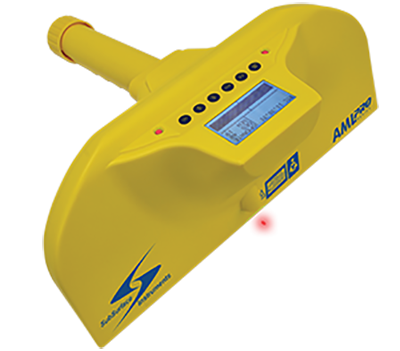
A handheld sold at £7,250 plus VAT that claims to find buried plastic pipe twenty feet down, through clay, wet soil and standing water. UK rules file it in the same licence-free class as movement detectors. On the evidence of its own manual, that is the more honest description. Here is the case, in five minutes.
- UK list price
- £7,250plus VAT. $8,250 at the US dealer
- On sale since
- 2012FCC certified that March
- Power allowed
- 0.75 mWaveraged, or about 75 mW on brief peaks
- Regulatory class
- Movement detectionone of its named uses
This device is being mis-sold. Not oversold. Mis-sold.
Both the claims it is sold on are false, and the physics behind it does not stand up. In fourteen years I have not found one UK utility mapping company using it, or one standard that names it.
I wrote the long version in June. Twenty thousand words, a source behind every line, researched with AI, which I have said openly from the day it went out. People asked for something shorter they could send round the office. This is that.
I am Pete Ashcroft. I run Sygma Solutions and I have spent twenty one years training the people who locate buried services. We sell radar and the training that goes with it, so I have a dog in this fight and you should know that. I have no relationship with SubSurface Instruments, or with anybody who resells the AML Pro.
Finding buried plastic is the hardest problem this industry has, and that is what this thing trades on. I have written separately on what can and cannot actually find it.
Sold as a revelation
Fourteen years on sale. Still called “All-New”. Still used by nobody.
Anyone who has been in this industry a while has known about this device since 2012. It was FCC certified that March and written up in the trade press that August, and the data sheet still calls it “All-New” today. If you are meeting it for the first time it will be presented to you as a breakthrough, which after fourteen years it plainly is not.
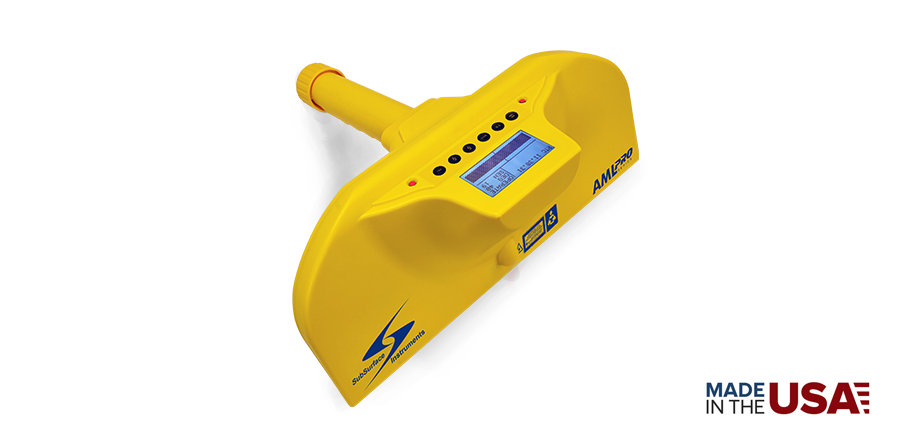
In fourteen years it has not appeared on the published method statement of a single mainstream UK utility mapping contractor reviewed for this work. It is not named in PAS 128, not in HSG47, not in NJUG guidance, not in the Survey Association’s published methods, and not in ASCE 38.
A handheld that genuinely found PVC pipe at twenty feet with no transmitter on it would have been standard kit at every survey company in the country inside five years. The money was there over that period and it moved. It moved towards instruments that measure.
Their own word for it
They call it powerful. Their own lab reading works out at 41 milliwatts.
Before any of the physics, there is a word in their own sales literature worth sitting with for a moment. This is the manufacturer’s current brochure, live on their website today, and the UK seller reproduces it line for line in the guide it hands to customers here.
“Using advanced circuit board technology, powerful 2.45 GHz ground penetrating, UHF radio waves locate PVC pipes easily.”
SubSurface Instruments, AML Pro brochure, current
Powerful. Ground penetrating. Their words, not mine. So let us take them at their word and ask the obvious question. How powerful?
There is a published answer, and it is in their own certification file. When the unit went to the laboratory in 2011, its strongest emission measured 111.4 dBµV/m at three metres. That is a field strength reading, which is how this class of kit gets measured instead of in watts.
Two figures get quoted for this device because they measure different things, so here are both. Averaged out, the American rule it is certified under allows 0.75 milliwatts, which is the number in the box at the top of this page. On brief peaks that same rule allows about 75, and their own laboratory’s reading works out at 41. I will use 41, because it is the most generous to them.
Forty one milliwatts. Forty one thousandths of a single watt.
That is the powerful part.
That number means little on its own. The device holds one FCC authorisation, granted in 2012, under a rule called section 15.249. That is not a rule for survey instruments. It is the low power gadget rule for the 2.4 GHz band.
Pull a cordless mouse off the FCC database and its test report is filed under that same section. So is a wireless keyboard. Same rule, same band, same ceiling. A cordless keyboard has to push a keystroke about a metre across a desk, and it is allowed getting on for twice what this device’s reading works out at.
So powerful, here, means a shade under what the keyboard on your desk is permitted.
Now set that against what the same literature asks you to accept. The manual says the signal penetrates up to twenty feet on average, with the depth depending on the substrate. The brochure says, separately, that the device works in clay, wet soil, snow or even standing water.
And on the opening page of that same brochure, a few pages before the powerful ground penetrating waves:
“Unlike the deficiencies of GPR (Ground Penetrating Radar), the AML will work in clay, wet soil, snow or even standing water.”
The same brochure, opening page
So it is not ground penetrating radar, and its radio waves are ground penetrating. One document, both claims, a few pages apart. I would genuinely like somebody to tell me which of the two they meant.
Either way the number does not move. Forty one milliwatts is what is being asked to find a buried pipe and come back up with something a surveyor can act on.
What happens to it on the way down is the rest of this page.
Who is selling it to you
Distributors of safety critical kit have a duty
I published this ten weeks ago. In that time I have been called jealous. Obsessed. A misogynist. A man with too much time on his hands and too many people listening to every word of his genius. All of it in public, all of it from the business development manager of the company that sells this device in the UK.
Not once, in ten weeks, has anybody come back with a factual rebuttal. Not one line about the physics. Not one number. Nothing about the patent, nothing about the FCC record, nothing about what the inventor himself told me.
Plenty about me. Not one word in defence of the device. If the physics were wrong it would take an afternoon to prove it, and I would publish the correction myself.
I have never named the distributor and I have never named an individual. I am not starting now.
But here is what I keep coming back to
This is safety critical kit. It goes into somebody’s hands on site and it is supposed to stop them putting a spade through a live cable. Anyone selling that has a duty to understand what they are selling.
Their own business development manager, publicly, back in June:
“[the distributor] just work’s with and supplies what works for the end user, it’s not our job to understand the technology a 100%, it either works or it doesn’t, most clients say it works for what they need it to do, to avoid damaging buried utilities or locate the stuff they just can’t find!”
A UK distributor's business development manager, publicly, June 2026
Read that twice. He knows exactly what it is for. Avoiding damage to buried utilities. And in the same breath, understanding how it does that is not his job.
Pushed on it in the same thread, he went further:
“if you need to understand it, to make use of it, don’t buy it, I don’t understand how my electric car works, but it works, most of the time, does that job?”
The same, in reply to a competing manufacturer's sales manager
That is his analogy, not mine, and it falls apart in his own hands. An electric car that works most of the time leaves you at the side of the road waiting for the AA.
A cable avoidance tool that works most of the time puts somebody in an ambulance.
There are only two explanations
They know it does not work
And it is being sold anyway at £7,250 plus VAT a unit. Ten weeks of this and not one person has come back with a single figure, a single test, a single line of physics. Only abuse. That is not how you defend a product you believe in.
They genuinely believe it works
Which would mean selling safety-critical detection kit for years without ever checking the physics of it, and deciding that understanding it is somebody else’s job. If that is the answer, then calling yourself the underground experts needs a rethink, because knowing how the thing in your hand works is the entire job.
I have gone round in circles on which of those is worse and I still do not know.
I make nothing from this, not a penny from anybody who reads it. I am doing it because while you are reading this there is a bloke somewhere being handed one of these and told it will keep him safe.
The science does not work
The signal is gone before it gets anywhere near your pipe
It runs at 2.45 GHz. That is not a slur, it is on the FCC certificate. And it is the exact frequency a microwave oven uses.
Ovens run at that frequency because water absorbs it well enough to heat food, while still letting the wave get a few centimetres in rather than scorching the surface. That is why your dinner comes out hot and the plate it is sitting on does not.
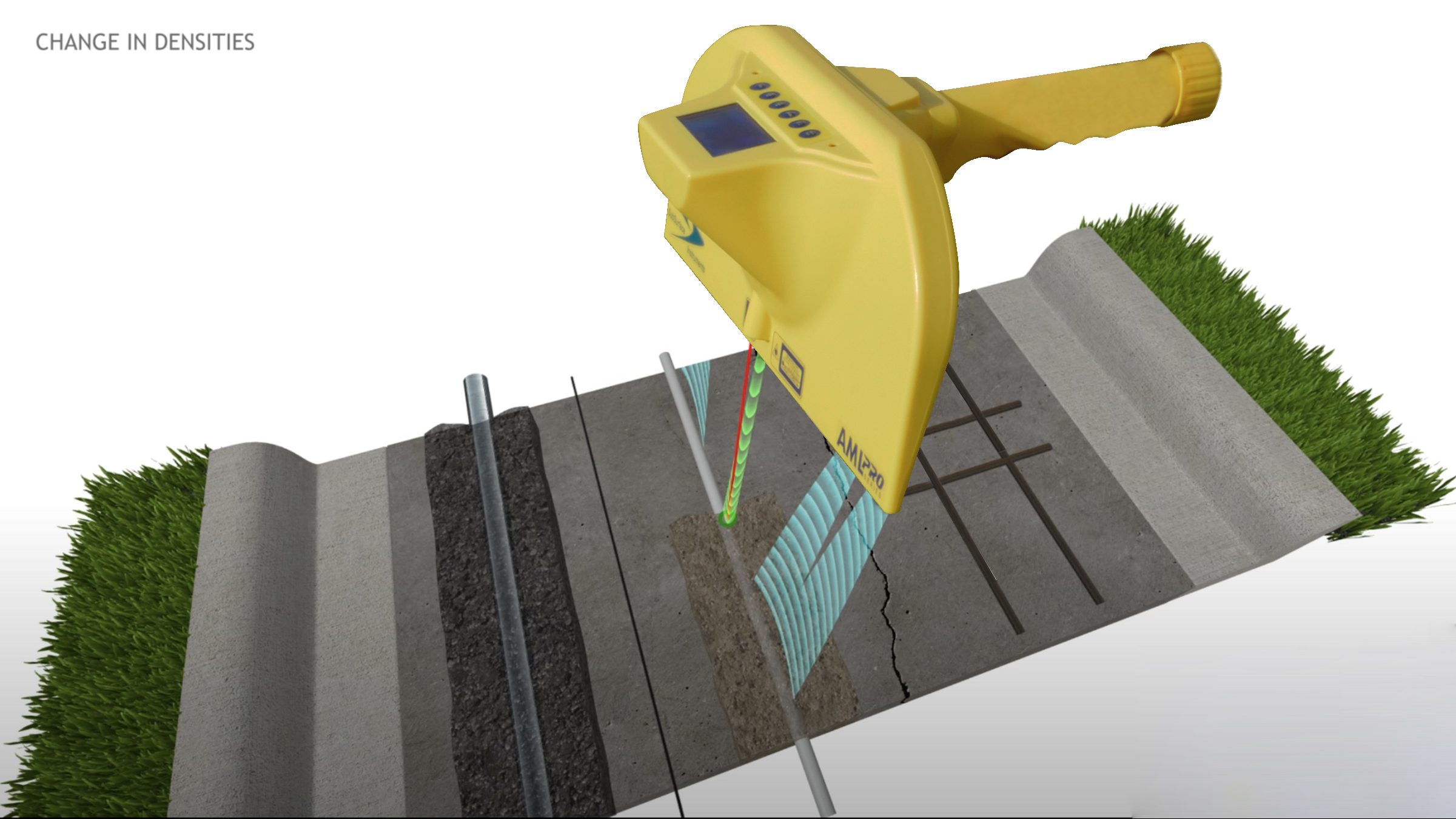
Now point the same signal at the ground. Wet clay is mostly water as far as a radio wave is concerned, and it does to that signal exactly what your dinner does to it. And I am not choosing wet clay to be awkward. It is on their own list. The brochure says the device works in “clay, wet soil, snow or even standing water”.
The measured figures are these. In pure water the signal is spent inside 1.4 cm, and in wet clay it manages about 3 cm, which is roughly the width of two fingers. The brochure promises 610 cm, and it has to make the trip back up again afterwards.
The shortfall is roughly 3,300 decibels. UK law allows this device about 134.
No antenna design, no signal processing and no amount of clever engineering closes a gap like that, any more than a brighter torch lets you see through a brick wall. It is not a hard problem waiting on better electronics, it is a closed one.
What it actually detects
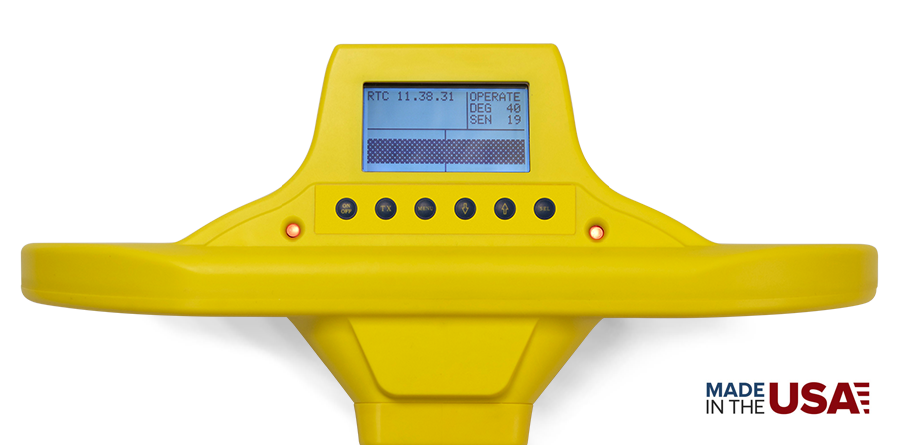
The one measurement it takes moves when your hand does
Inside it there are five aerials in a row, one that sends and four that listen. None of this is guesswork on my part, it is all set out in the inventors’ own patent.
The one measurement it takes is this. A radio wave is a ripple, and the two listening aerials sit at slightly different points on it. The device measures how far apart those two points are, a chip compares them and puts out a voltage, and when that voltage sits at about 0.2 volts the light comes on. Drift off it and the light goes out. There is nothing else to the decision.
What it never measures is how long the wave took to go down and come back again. That timing is the only thing that gives you a depth and it is what real radar is built on, and there is no timer in this device at all.
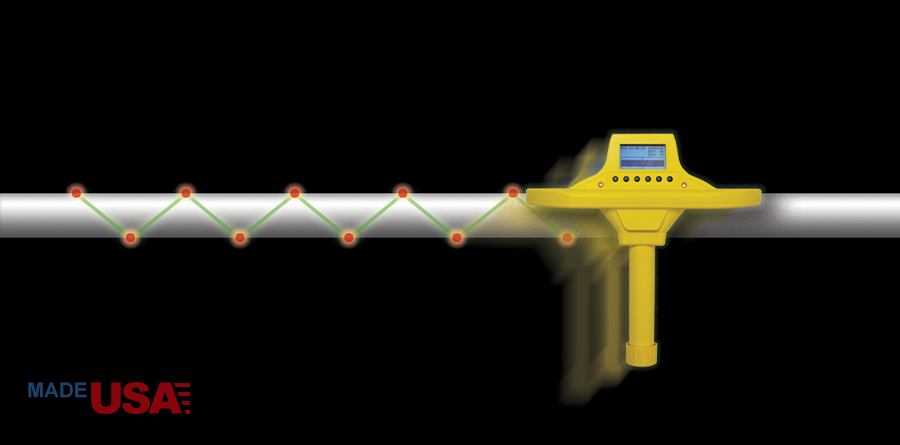
One ripple at this frequency is about 4.8 inches long, so half a ripple is 2.4 inches. Move the device that far, or simply tilt it as you walk, and two aerials that were in step with each other are now opposite, and the reading flips over. The inventors put it in the patent themselves:
“the measured phase difference can vary rapidly with slight movements of the apparatus”
US 7,898,456, Cloutier and Oehme
And the manufacturer tells its own customers the same thing, from the other end:
“Both lights will come on then go off approximately every 2 inches… A gentle flicker up and down or a vertical motion will allow the pipe to be accurately re-located.”
SSI AML FAQ
And before anyone tells me they would settle for half a metre. Nobody needs to argue about twenty feet, so take the depth that actually matters on a job, a service at around half a metre down. In wet clay that round trip costs somewhere between 145 and 290 decibels, and UK law allows this device about 134. Half a metre has already gone, and a metre has gone by a mile.
One more from their FAQ. Asked why it gives readings where the user knows there is nothing buried, the answer is to turn the sensitivity down. Winding gain down to cut noise is ordinary practice, on GPR and on a CAT alike, so that proves nothing either way.
Could it be reacting to something other than the operator? It could. The signal does reach the top inch or two, and that means the device can respond to what is up there. Over a reinstated trench there is something to respond to: ground somebody dug out and put back, looser and wetter than what sits either side of it, running along exactly the line of the pipe.
So there may well be two things moving that indicator. A phase reading that flips every 2.4 inches when a wrist moves, and a change in the top of the ground where a trench was once cut. Neither of them is the pipe.
Whatever is moving that indicator, none of it is a pipe at the depth that matters. Nothing gets down there, so nothing comes back.
They call it the All Materials Locator
Arm Movement Locator
Same three letters, and a rather more honest name. As it turns out, the regulator files it under movement detection anyway.
Selling point one
There are no NASA engineers. I found the man who built it instead.
The manual and the brochure say the technology was “originally designed by NASA engineers for use in lunar exploration”.
The orbital sounders NASA and ESA have sent to the Moon and Mars, Apollo 17, MARSIS and SHARAD, all work between 1.3 MHz and 158 MHz, for exactly the reason above. NASA has never flown a lunar radar at 2.45 GHz. The only lunar radar anywhere near that band is on China’s Chang’e-5, which landed in 2020, eight years after the AML Pro went on sale. Apollo’s lunar sounder was a 43 kg instrument with a sixty metre antenna and a spacecraft’s power budget, working through dry lunar dust at 5 MHz. This is a 2.5 lb handheld proposing to beat it in wet British clay.
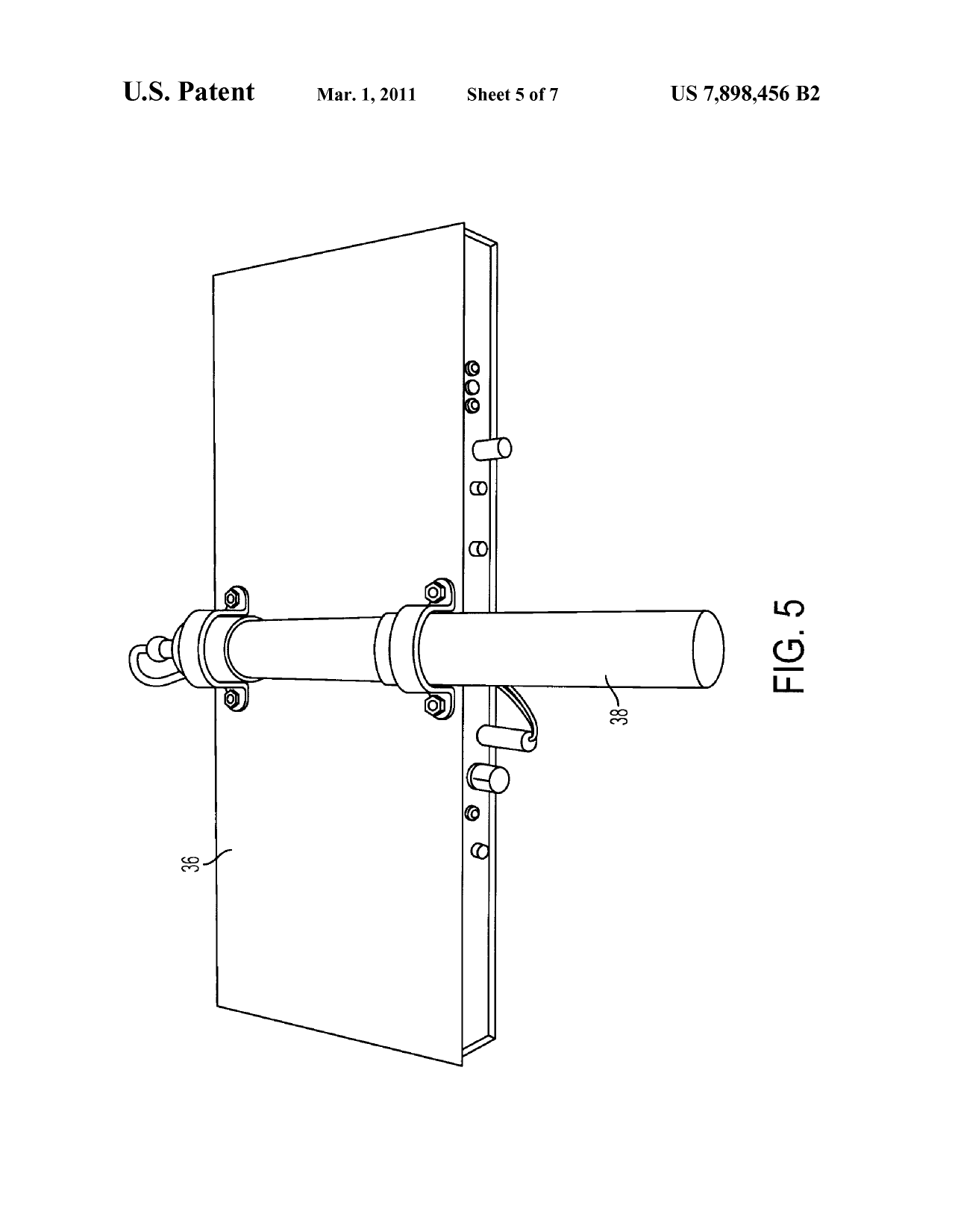
So I went looking for these NASA engineers, and there are none. The patent names two real people instead, and I wrote to the one still with us, Professor Paul Cloutier, a physicist at Rice University, fully expecting to hear nothing back. He replied within the hour, and twice more the day after that.
It was never a space programme. It began as a landmine detector for the US Defense Department. An early version was trialled by the Army at Fort Belvoir against mines at two to twelve inches, in prepared lanes of known soil. That is about the easiest task you could set it. It was disqualified anyway, because it indicated on empty ground more than one time in five. A device that lights up over a fifth of empty ground is not detecting anything, it is simply indicating nearly everywhere it goes.
They went on to test it against PVC water pipe buried at one to two feet, which is a long way short of twenty, and then they stopped altogether. I asked him why.
“the fact that we did not pursue it any further is a summary statement of our understanding of its utility and value at the time.”
Professor Paul Cloutier, co-inventor, in correspondence for this report
He read the report before publication and allowed me to quote him.
There was no space heritage to exaggerate in the first place, and the two men who designed the thing looked at what it could do and walked away from it.
Three more, briefly
The patent, the licence, and who carries it
The patent
It died in 2023
US 7,898,456 expired on 3 April 2023 for unpaid fees, with SubSurface Instruments owning it. They still lead the product page with “Patented Technology”. And a patent only ever tested whether the idea was new, never whether it worked.
The full patent recordThe licence
Real radar needs one. This does not.
Run GPR here and Ofcom want a licence, an anti-tilt cut-off, a log of every use. This needs none of it, because the regulator files it not as radar but as movement detection. The American rule it is certified under allows 0.75 milliwatts averaged, and about 75 on brief peaks, a fraction of your wifi router.
What the regulator makes of itYour liability
If it goes wrong, you carry it
HSG47 paragraph 91 says locators do not find plastic, bar ground probing radar, and its own marketing sells it against GPR. After a strike you have nothing to point at. Not a standard, not a test, not even the seller’s own claim.
HSG47 and PAS 128 in fullThe pushback
What you will be told, and what to say back
There are five defences of this device. I have heard all of them. Here is what each one is worth.
- They say: “There is a peer-reviewed study proving it works”
One paper exists. Lee and Yun, 2025. All 32 trials were run by the same operator, every one in dry weather with no rainfall for three days beforehand, all on the authors’ own testbed where the pipe positions had already been surveyed.
The authors say the rest themselves. Their discussion calls the soil “favorable”, the results “an ideal-case scenario”, and warns that clay or saturation could “significantly alter” the accuracy. Those are the two conditions the marketing is built on.
And its “third-party technical reports” turn out to be SSI’s own manual, a distributor brochure and a retailer’s product page.
The paper taken apart, point by point- They say: “It is FCC certified”
That certifies it transmits legally. It says nothing about whether it works, and the FCC has no jurisdiction over PAS 128, HSG47 or NJUG.
The Quadro Tracker carried its FCC ID printed on the case as a credibility cue. There were no working electronics inside it at all.
What the certificate actually covers- They say: “It is patented technology”
It expired in April 2023 for unpaid fees, while SubSurface Instruments owned it. Expired technology is not patented technology, whoever owns it.
And a patent establishes that an idea is new, never that it works.
The full patent record- They say: “Our customers say it finds pipes, here are the photos”
Ten photographs of exposed pipes is ten pipes. It is not a detection record. No misses in that album, no empty holes, no runs where the lights stayed dark, and no case where somebody buried a pipe the operator had not been told about.
Finds get collected. Evidence gets counted.
“Most clients say it works” is the whole argument, stated honestly, and what it amounts to is belief. Belief is not a method statement and it will not help you after a strike.
- They say: “There are dozens of videos of it working”
Watch the ground, not the device. Look for what the operator already knows. A reinstatement scar. A strip of tarmac a different colour. A stop tap at one end and a manhole at the other. A line already walked once. In footage like that the pipe’s position is not being discovered at all, it is being confirmed.
Then watch the hand. In almost every clip the operator is working in short passes, roughly a couple of inches at a time. That is the whole distance the thing needs. Half a ripple at this frequency is 2.4 inches, and moving the device that far is what flips the indicator, with or without a pipe underneath it.
Then ask what you are not shown. Nobody uploads the pass where the lights stayed dark, or the dig that found nothing. A video is not a test. It is a demonstration where the answer was known before the camera started.
And remember the one time this technology met a controlled trial. Prepared army lanes, targets at two to twelve inches, disqualified for indicating on empty ground more than one time in five. A highlight reel structurally cannot show you that.
Why unblinded demonstrations prove nothing
What to use instead
The methods that work all tell you how they work
Active EM puts a signal onto the pipe or cable itself and reads the field it re-radiates. It works on conductors, and it says so.
A sonde is a transmitter physically pushed inside the pipe. It works in any material, because the source is inside.
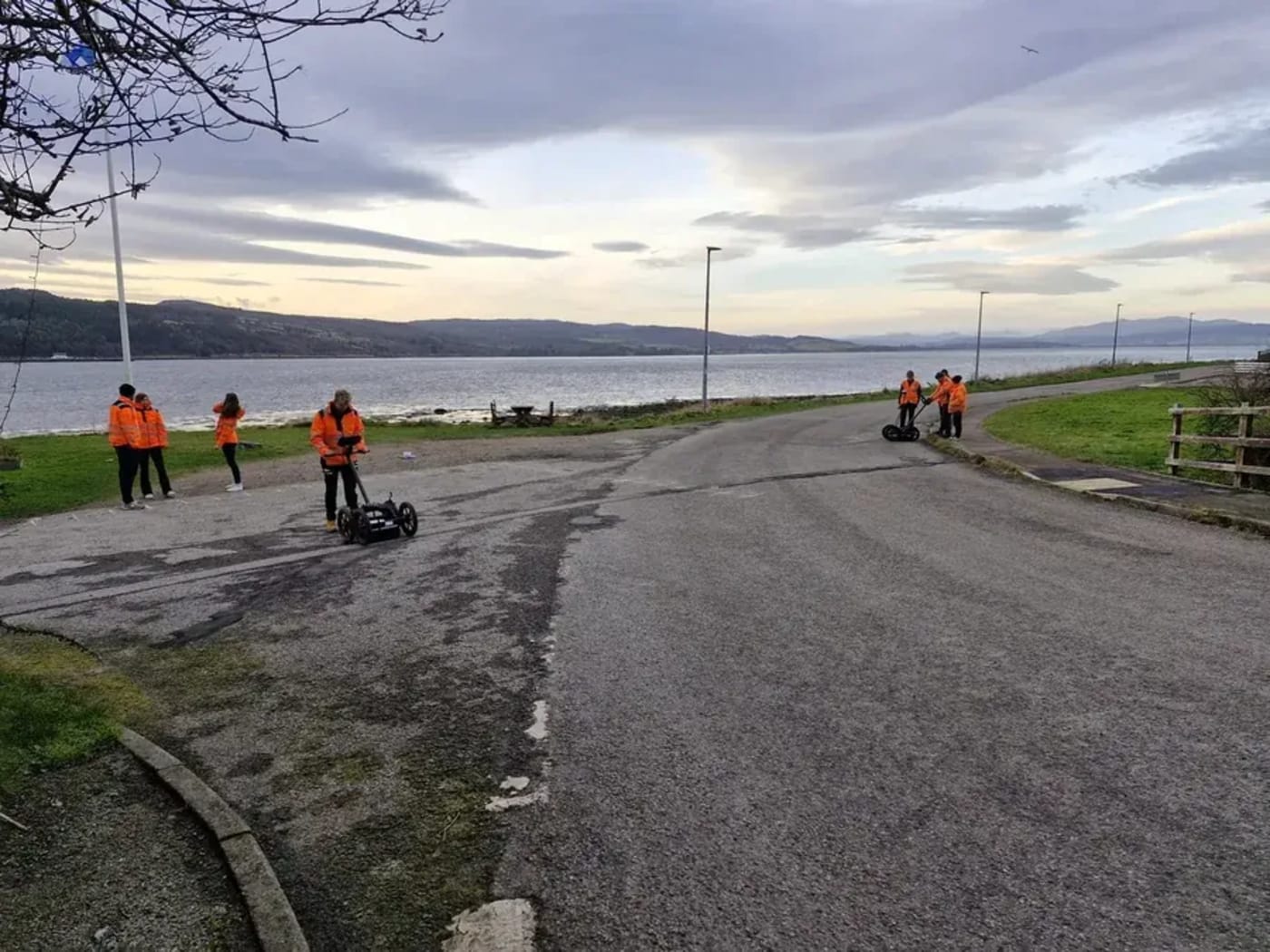
GPR at 200 to 1,500 MHz measures travel time and records a radargram you can re-read. Every manufacturer publishes the frequency, the depth assumption and the soil conditions where it struggles.
None of them claims to work in clay, wet soil, snow and standing water without qualification, because no such claim survives contact with the physics. If someone has sold you an AML Pro, do not put it in front of an excavator as your locating method of record, and treat any indication it gives as unverified until a second method confirms it.
Every claim above is sourced in full
The full investigation runs to twenty thousand words across sixteen sections: the link budget worked through, the patent and assignment record, the inventor’s testimony, the Korean paper taken apart point by point, and every source URL.
Read the full investigationAlso on the AML Pro: why people think it works · the power figure that is not in the instructions · the Korean study said to prove it works · the index to everything
Sygma Solutions runs HSG47, EUSR CAT 1, Cat & Genny, GPR and PAS 128 training across the UK. View all courses