Field note · Genny and CAT
Genny and CAT depth readings: what they are for, and how to test one
A depth reading is an estimate, not a number to dig to. Its real job is to tell you more about what is in the ground, and even a reading that fails its checks is telling you something.
Genny only
Depth works in Genny mode, on the plus models
A distance
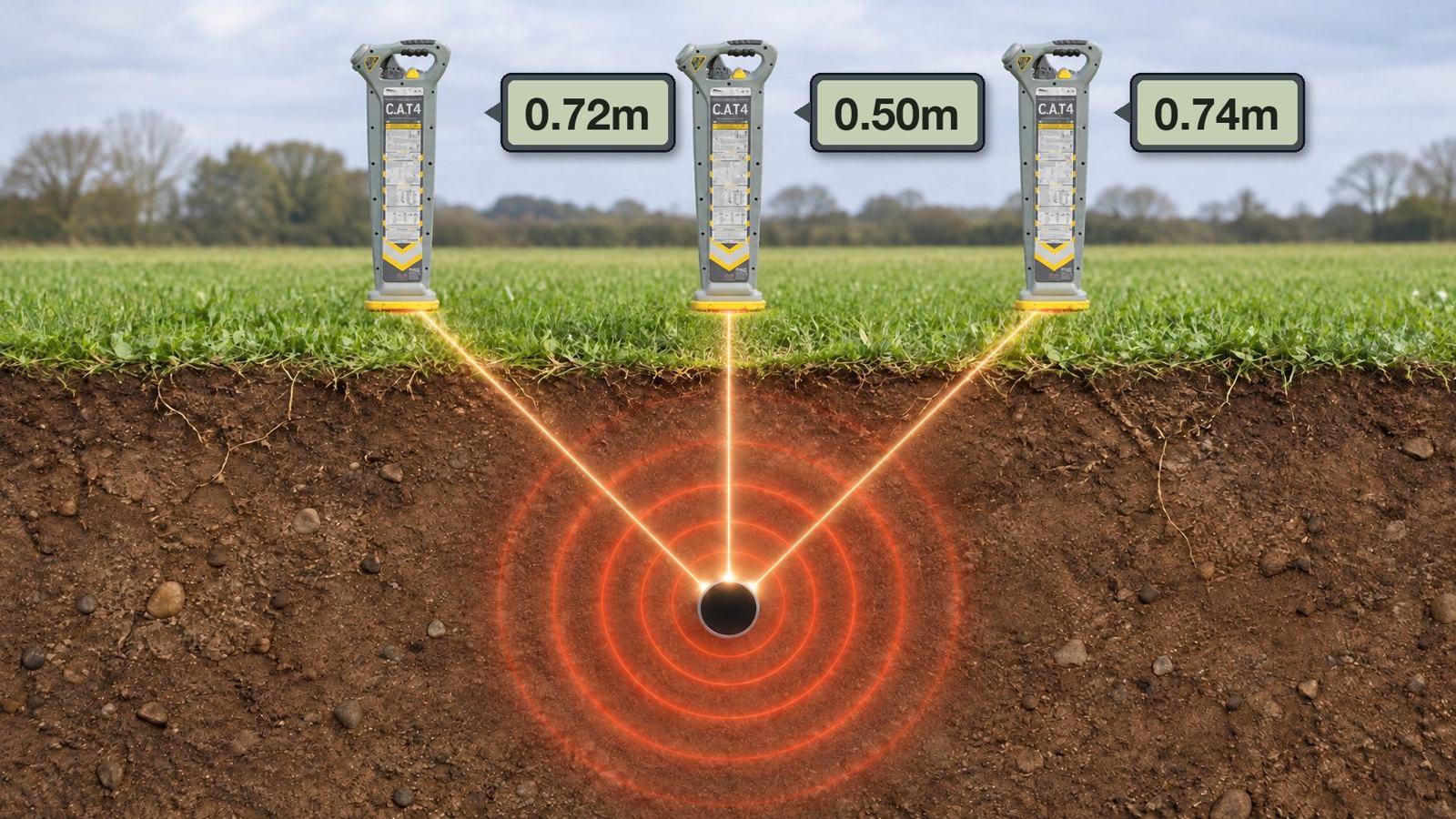
The CAT measures distance to the signal, not depth
Test it
Every reading, every time
Never
A reason to decide on machine digging
There is a bit of confusion in the industry around CAT depth readings, and there has also been some confusion about what Sygma teaches on them.
We don't teach that a depth reading is accurate and can always be trusted. We teach that it is an estimate, that it has to be tested every time, and that the checks matter more than the number.
The working rule
- Depth is information, not a number to dig to.
- Get it with the Genny: connected or clamped if you can.
- Pinpoint first, CAT on the floor, tap and let go.
- Test it: lift, step away, come back in, check along the line.
- If it fails, no depth at that spot. Ask why, move along.
- Still only a guide. Never decide on a machine from a depth.
01
What a depth reading is for.
A lot of firms think depth is only there to tell you whether a bucket can go in. It isn't. A depth reading is there to give you more information about what is down there. Is it the same cable I was tracing? Is there another one under it? Has the signal jumped onto something else?
And even when the checks fail, that is more information. Readings go wrong because something is distorting the signal: a sudden change of depth, a bend, a loop, a T junction or more than one cable. So a failed check is telling you that something down there is causing it, and you need to find out what.
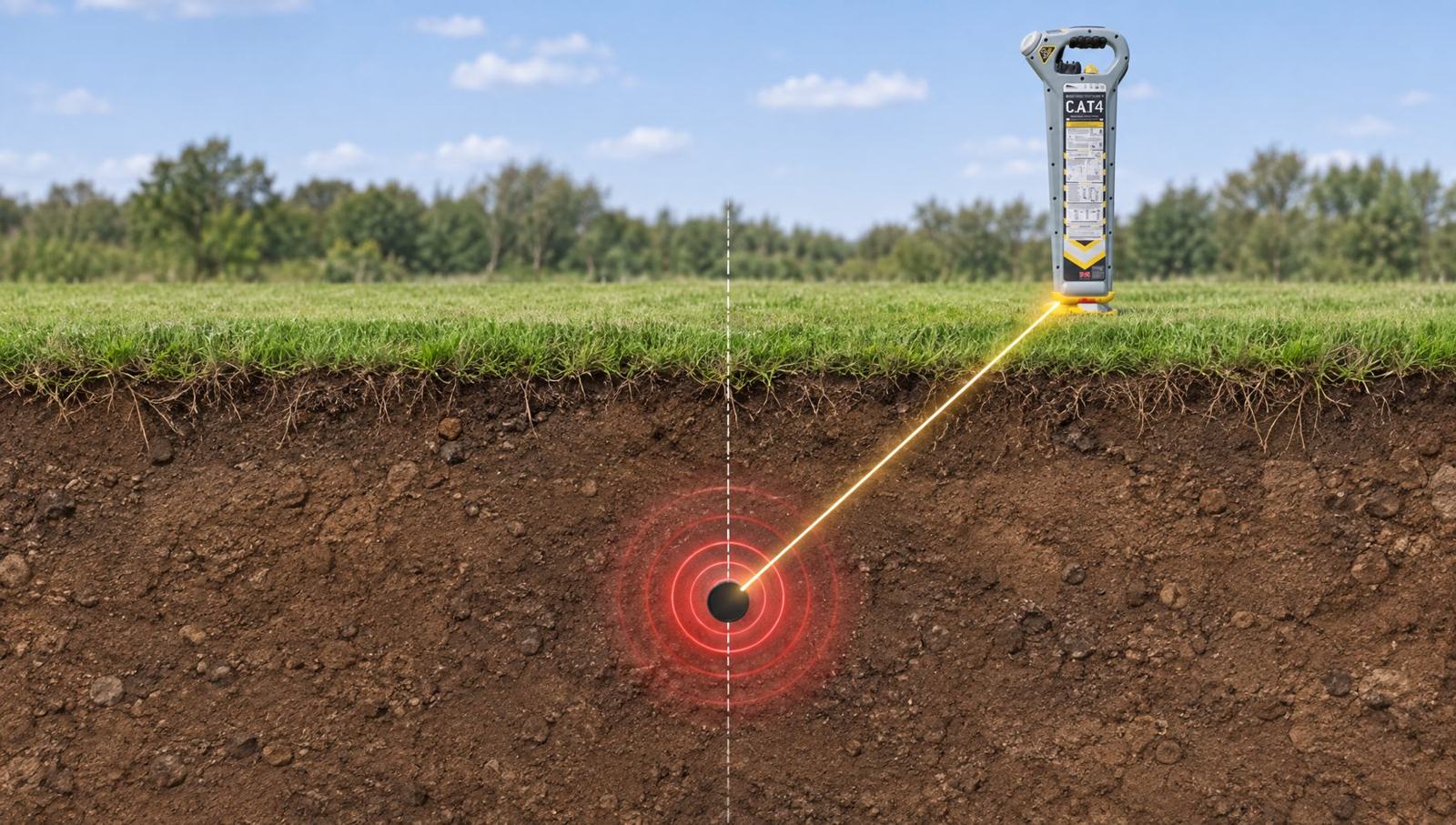
The CAT doesn't really measure depth. It measures how far it is from the signal, and it has no idea whether you are stood over the cable or a foot to the side. When someone tells us depth is useless, it is usually because they took a reading without checking it.
Always to the centre of the service
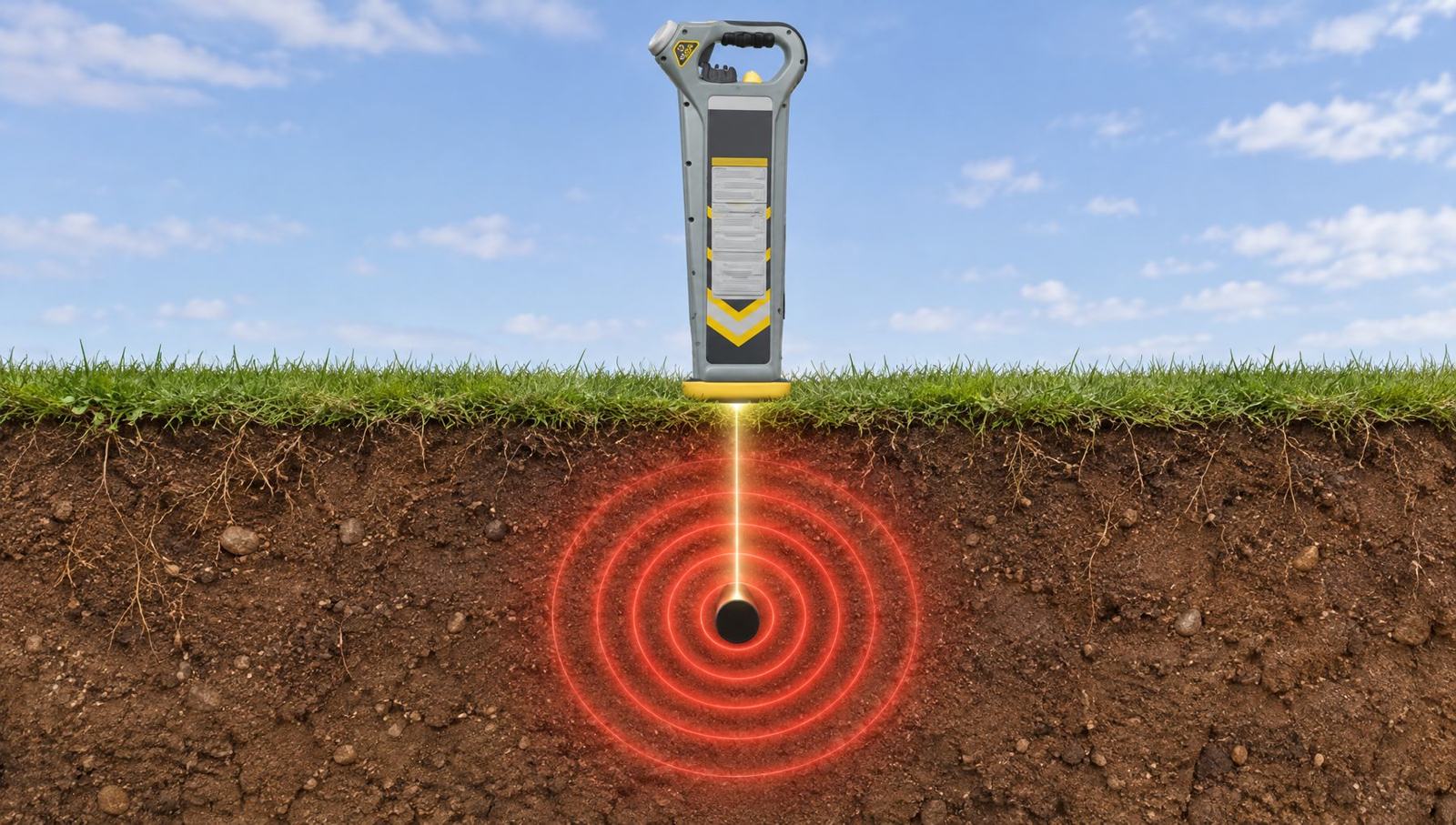
A depth reading is to the centre of the service, not the top. On a small cable that hardly matters. On a big metal pipeline it matters a lot, because the top of the pipe is a lot closer than the number on the screen.
Radiodetection: "Measurement is to the center of the pipe or cable. Depth of cover is necessarily less than the reading, possibly critically on large diameter pipes."
The ABC & XYZ of Locating, page 59
02
How we test a reading.
Pinpoint first, CAT on the floor, one tap of the button. Then the checks.
Pinpoint the line first: watch the bars rise and fall and stand right over it. Put the CAT on the floor, upright and across the line, and hold it still. It isn't calibrated for the length of your leg.
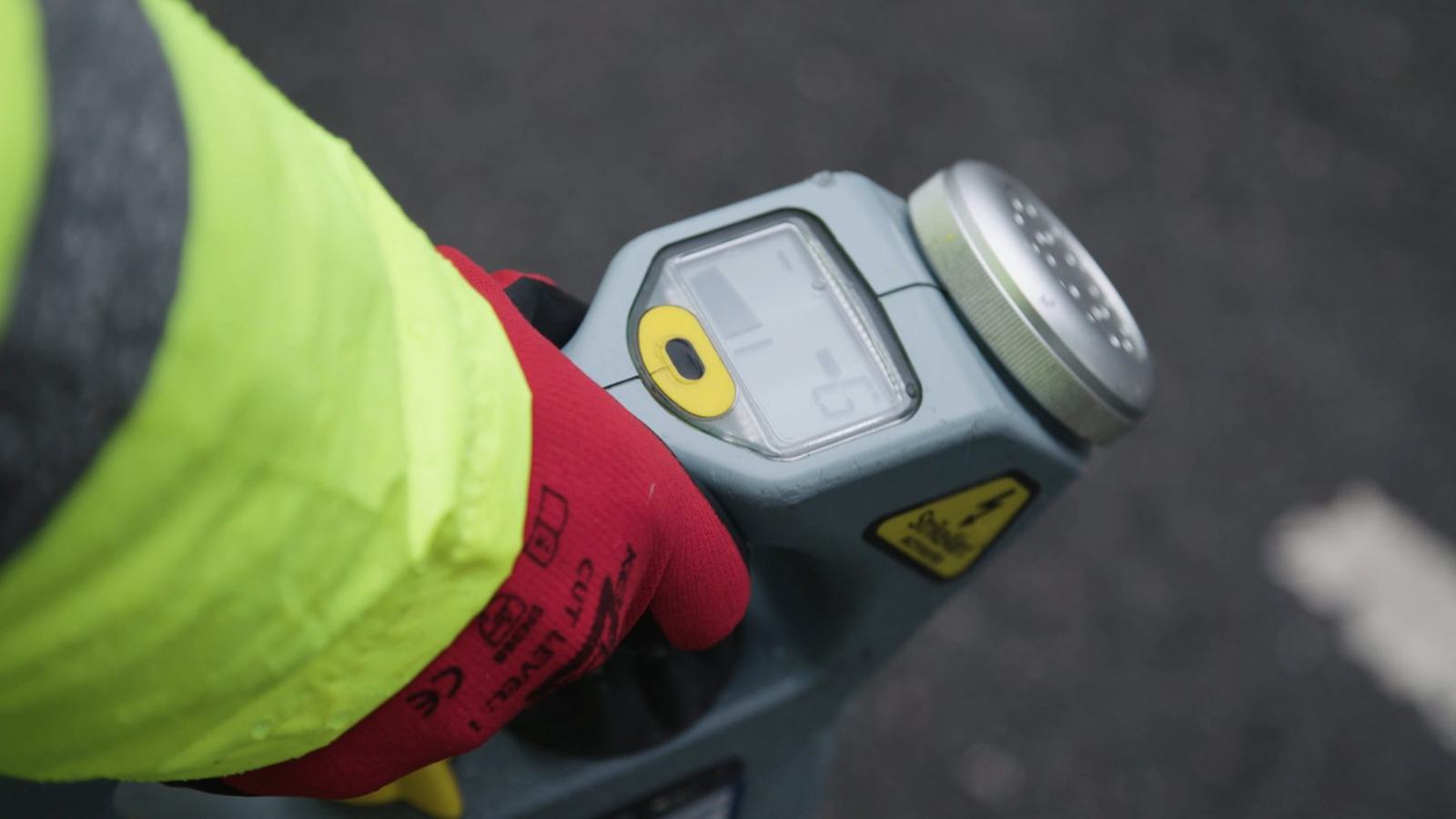
Tap the depth button and let go. Holding it in tells the CAT you are looking for a sonde, which is a different sum and reads far too deep. If you have been getting readings of two metres over a shallow service, that is usually why.
If it passes the checks below, mark it. If it doesn't, you can't get a reliable depth at that spot. Move along the line and try again.
 1
On the floor
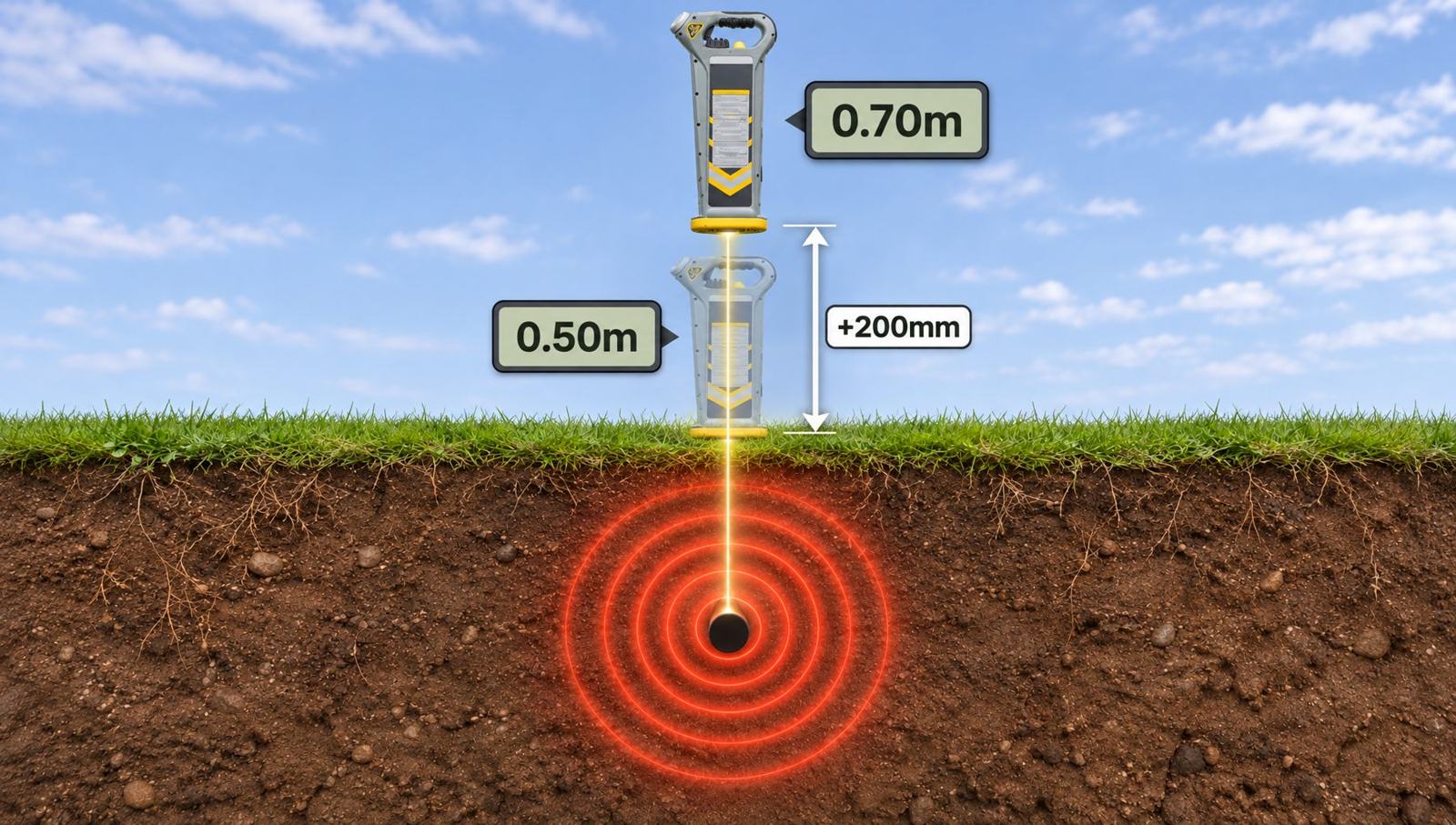 2
Lift it
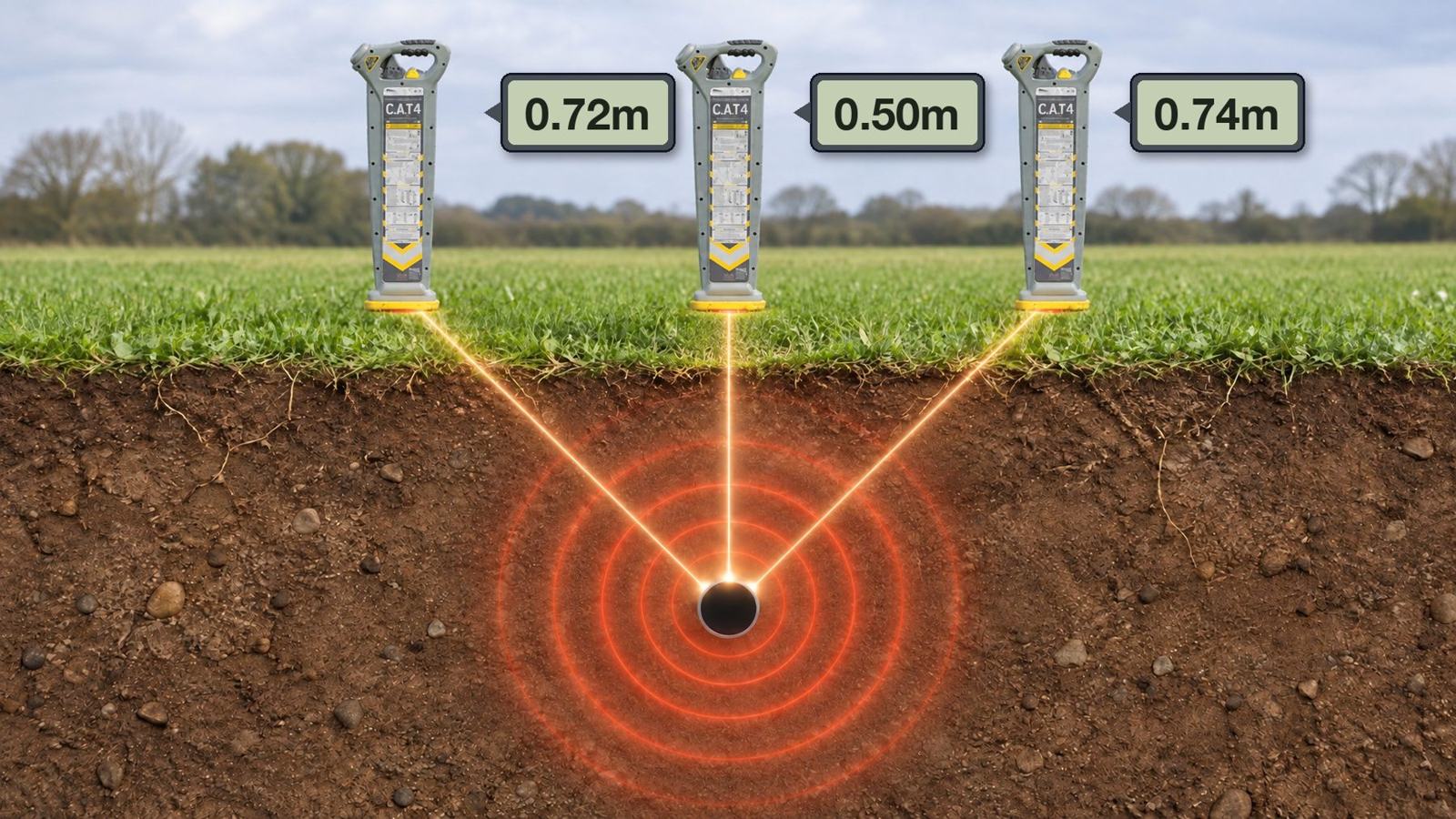 3
Step away, come back
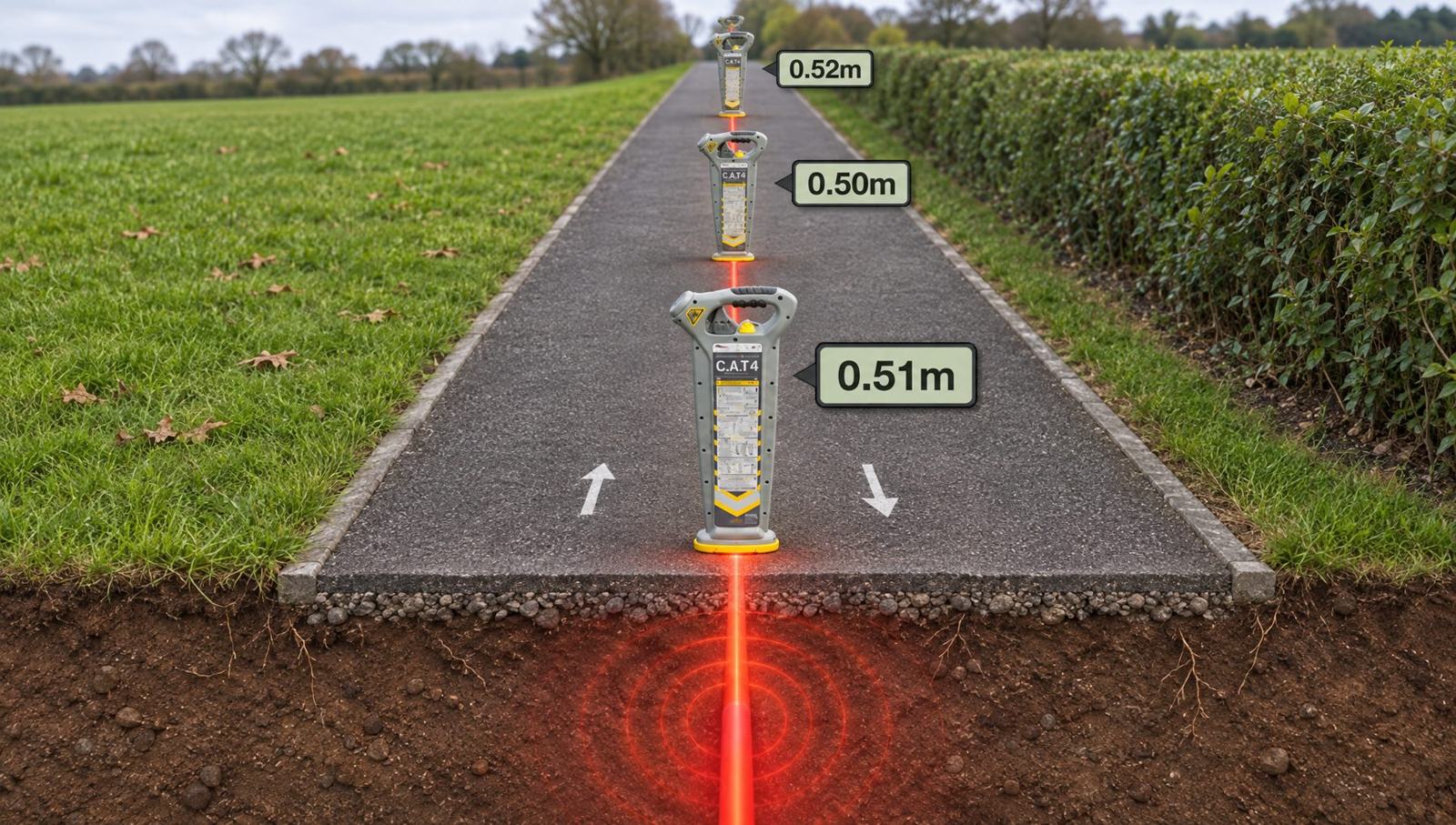 4
Check along the line
03
"Don't take depth near a bend." How do you know?
You often can't see one from the surface.
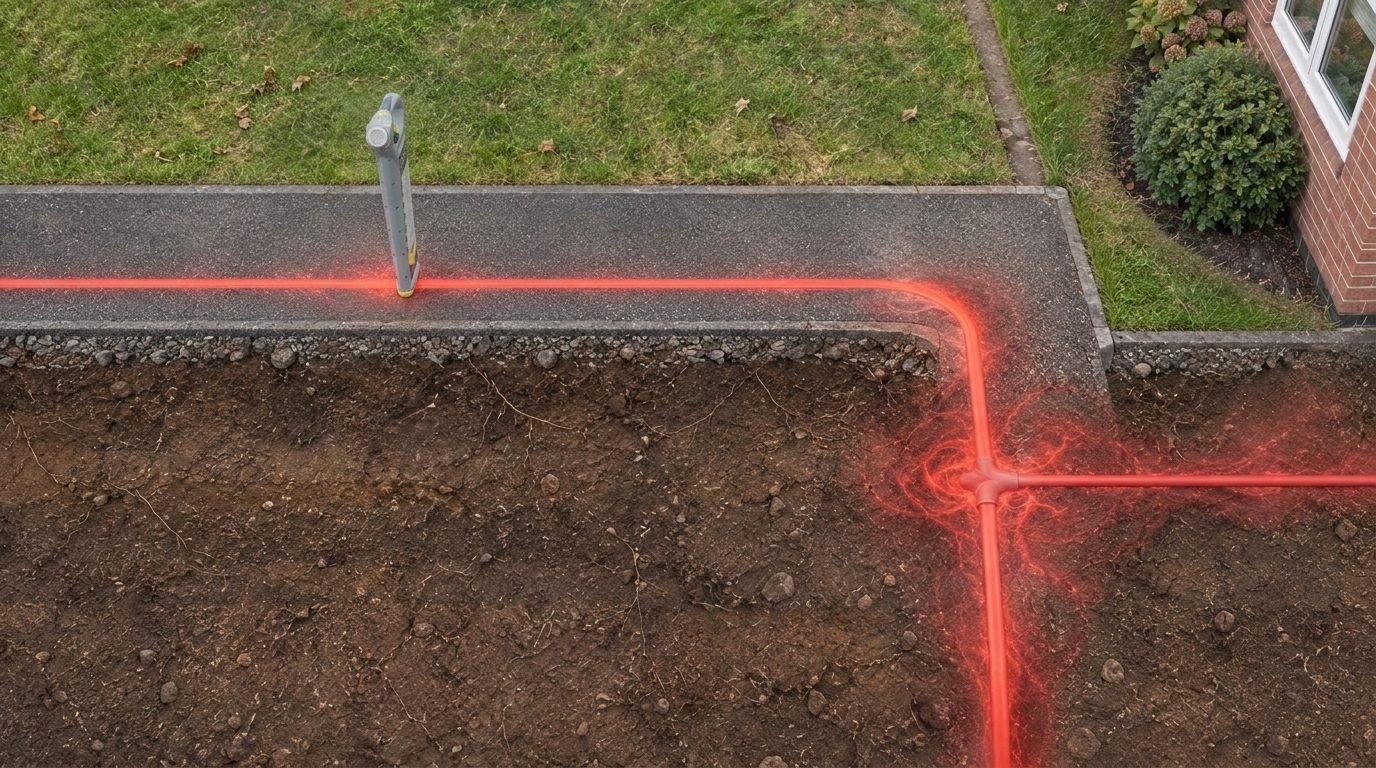
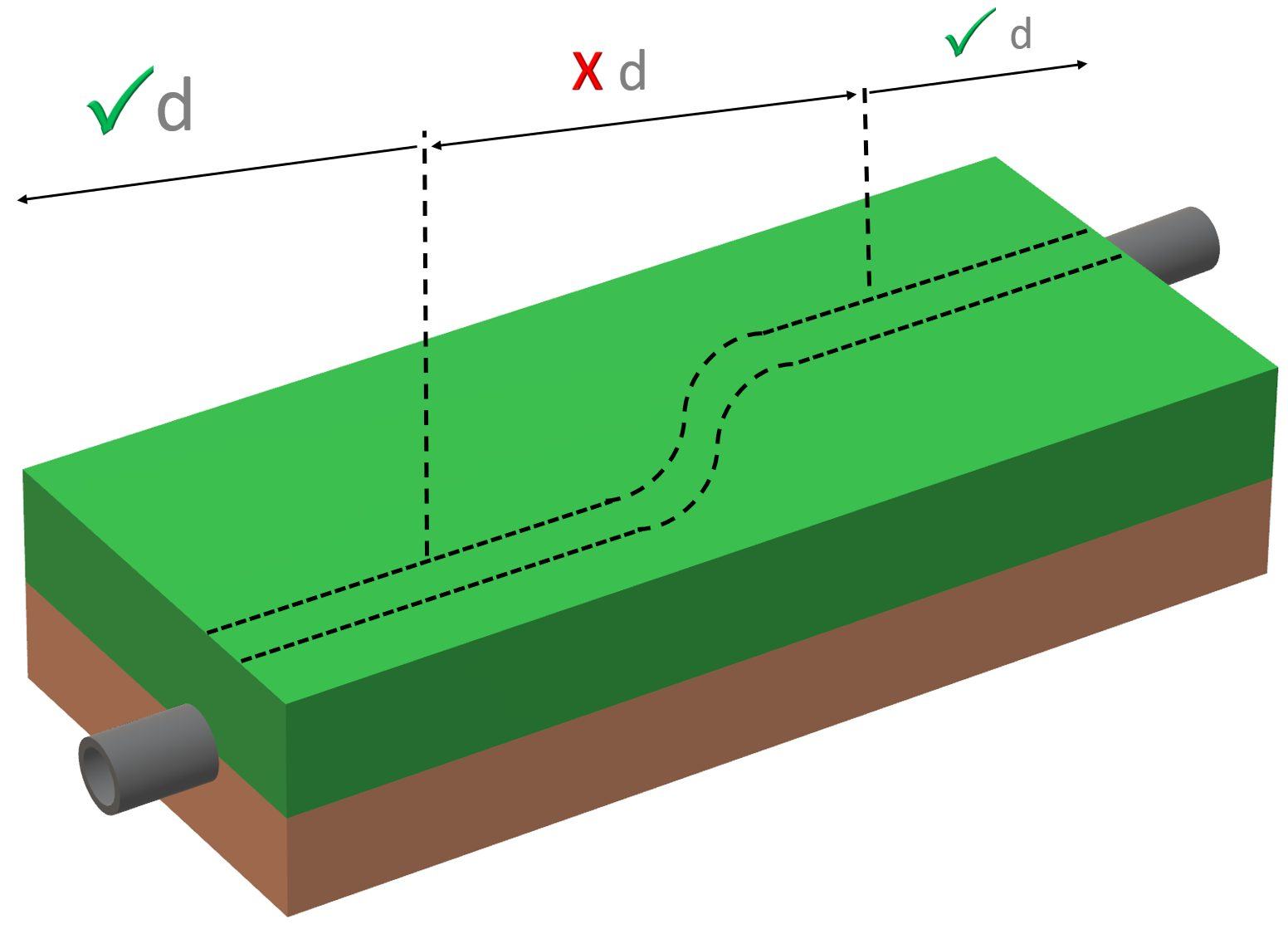
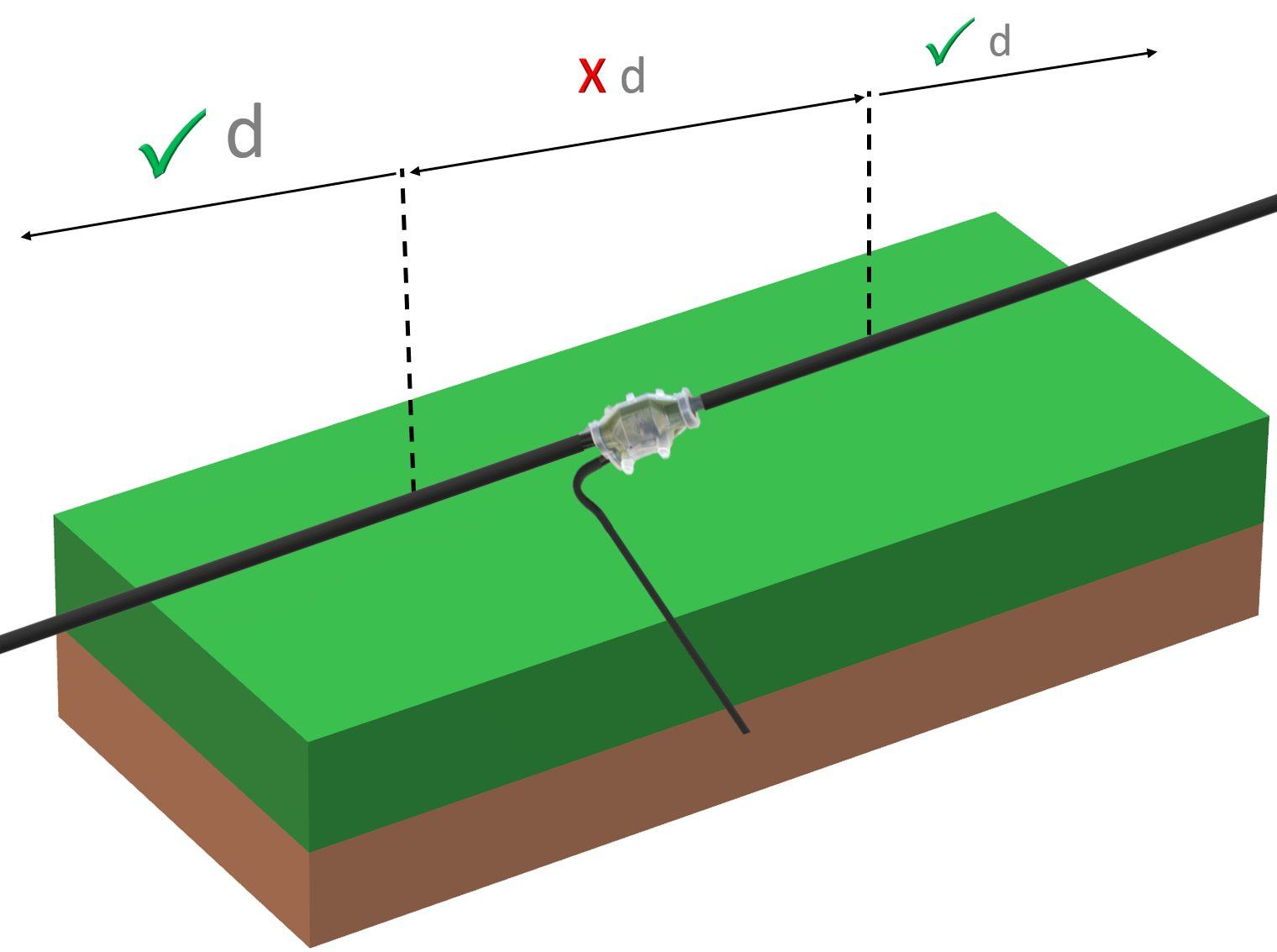
Some you can work out. A column, a house, a meter box or a junction on the plans all mean a connection. Stay a metre or so away from it, ideally a metre and a half.
Some you pick up while tracing. If the signal suddenly drops over a short distance, the cable has either turned or a branch has come off it. A lot of people just think it has gone deeper and carry on. A cable getting deeper fades off gradually; it doesn't nosedive.
The rest, the checks find for you. Near a bend or a tee the field is bent out of shape, so the lift doesn't add up and the readings won't settle. You can't remove the bend. You just say there is no reliable depth here and move along. And that failed check is useful: something is distorting the signal, and you need to find out what.
C.Scope list "a curve or bend", "close to where the service changes in depth", "near to a 'T' junction" and "where the signal has coupled onto an adjacent service". Vivax's vLoc3 handbook says a reading "on congested areas or close to bends or tees may be inaccurate".
04
When depth readings suggest more than one cable.
Say there is a lighting column, and the plans show an LV main along the footpath. We clip the Genny onto the column and find a cable at a mark, 300 mm deep. Is that the lighting cable, or the LV main the column is fed from?
So we clip onto a house, trace its service back to the main, and come back to the same mark. Same position, but now it reads 600 mm. Two readings that don't agree at the same mark make us suspect the lighting cable is sitting on top of the LV main, and that is the cue to prove it. Without depth, that mark would have looked like one cable.
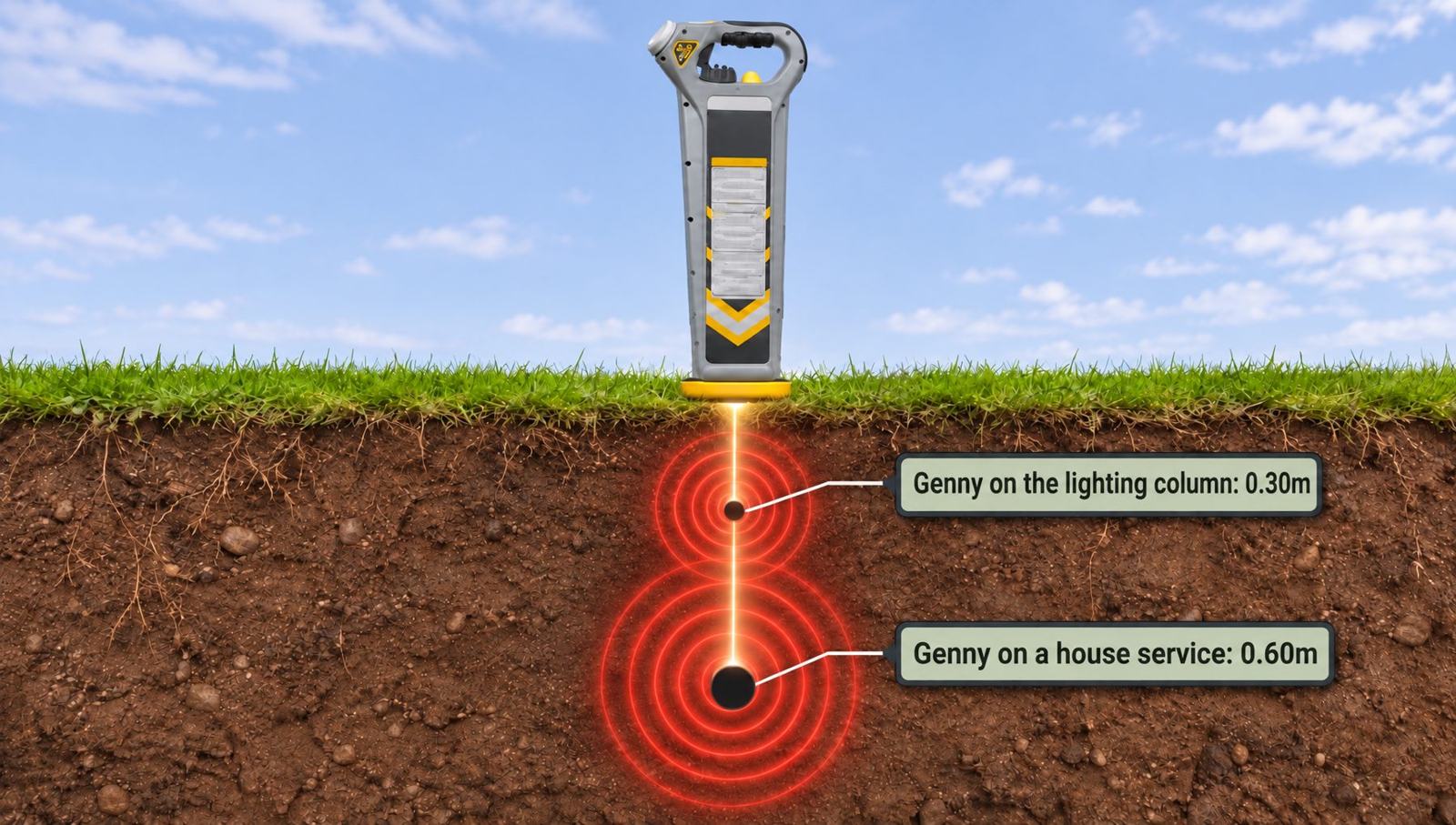
The same can happen with two house services, or with other services laid on top of each other. And if the depth suddenly changes while you are tracing, the signal may have jumped onto something else. A depth that won't settle can be the first sign too: Radiodetection call a nearby line carrying signal "the most common source of error of depth measurements".
Depth on its own can't prove there is only one cable. It is one clue, alongside hooking up to each service in turn, reading the plans, and nulling out the big cable to find what is next to it. But it often makes someone stop and ask, "am I still tracing the same thing?"
05
Has the signal jumped from the electric to the water?
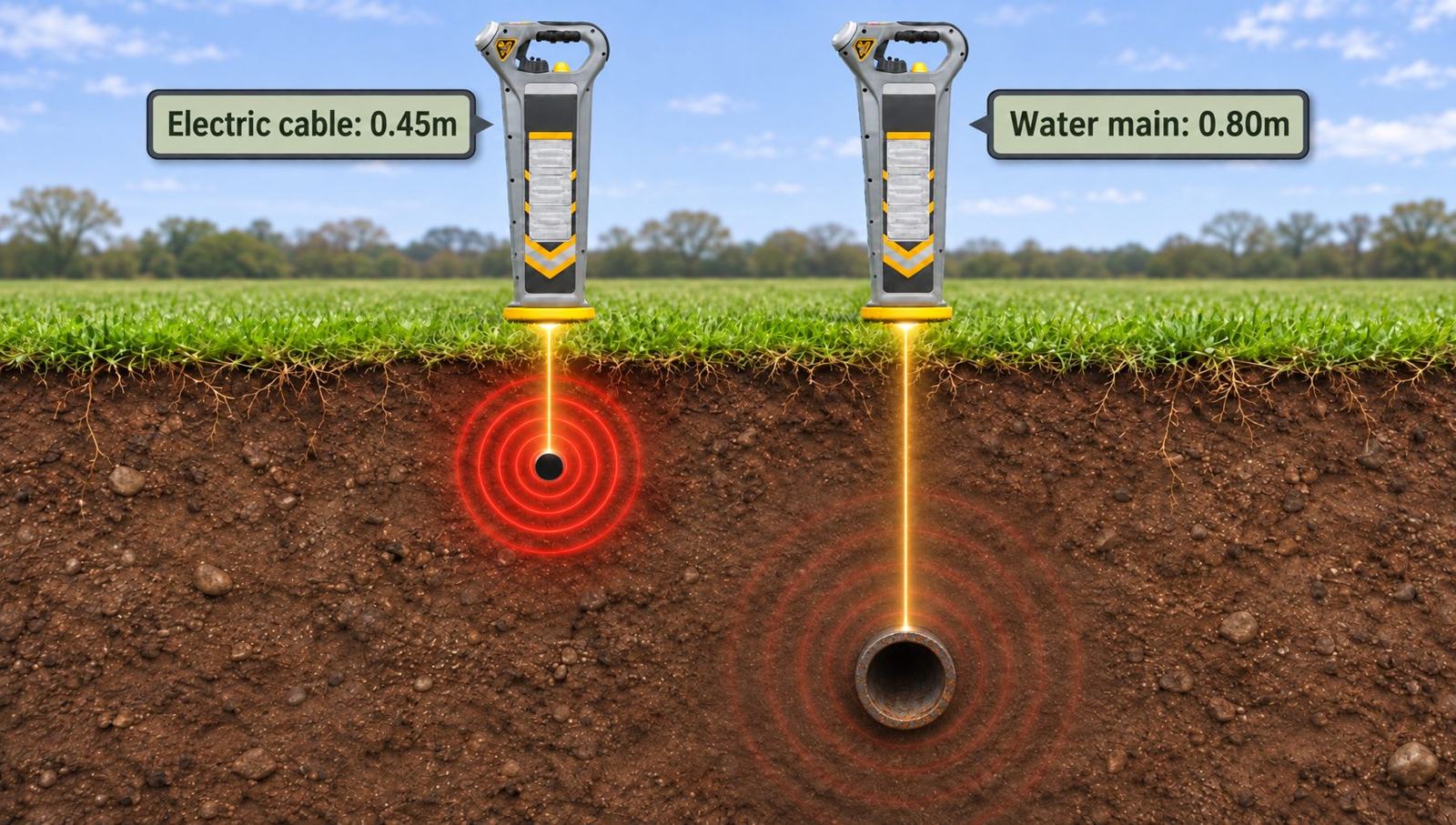
Signal often jumps from an electric cable onto a metal water main, or the other way round. We get asked all the time: how can you tell which one you are on?
One way is to follow each signal and see whether it links up with where you expect the main to be. The other is to take depth estimates on each. It can't be guaranteed, but water is often deeper than electric.
Watch the signal strength too. The deeper pipe can be carrying more signal and still give the weaker response at the surface, so the loudest line is not proof of which service you are on.
None of this is a guaranteed answer. What it does is give you more information to help piece things together, and a reason to prove it before anyone digs.
06
Judging depth without the depth button
Even without the depth button, someone who is trained properly and uses the equipment correctly can roughly gauge depth from how the signal strength meter drops off either side of the line.
Move across the line and watch the needle. The quicker it drops off, the shallower the cable usually is. A sharp, narrow peak means shallow; a flat, wide one means deep. You get that straight away, before you press anything.
On a flat signal, find the highest point, put your foot there, take several quick depth readings, and mark where the shallowest one is.
06
Switch depth off, leave StrikeAlert on?
Some people are against using depth, but quite happy for their teams to have StrikeAlert, which is worse. It is a dumbed-down depth feature: it works in power mode, so no Genny, it gives no number, and there is nothing to test. It gives false alarms, often a metre or so off the cable, and turning the sensitivity down won't stop it.
Radiodetection's own guide: "StrikeAlert may not activate even if a live power cable is present." Yet crews take no alarm to mean they have 300 mm to play with.
So we tell people to turn StrikeAlert off, put a Genny on and take proper depth readings they can test. A trained operator can read shallow or deep from the needle anyway (see left).
07
Still only a guide.
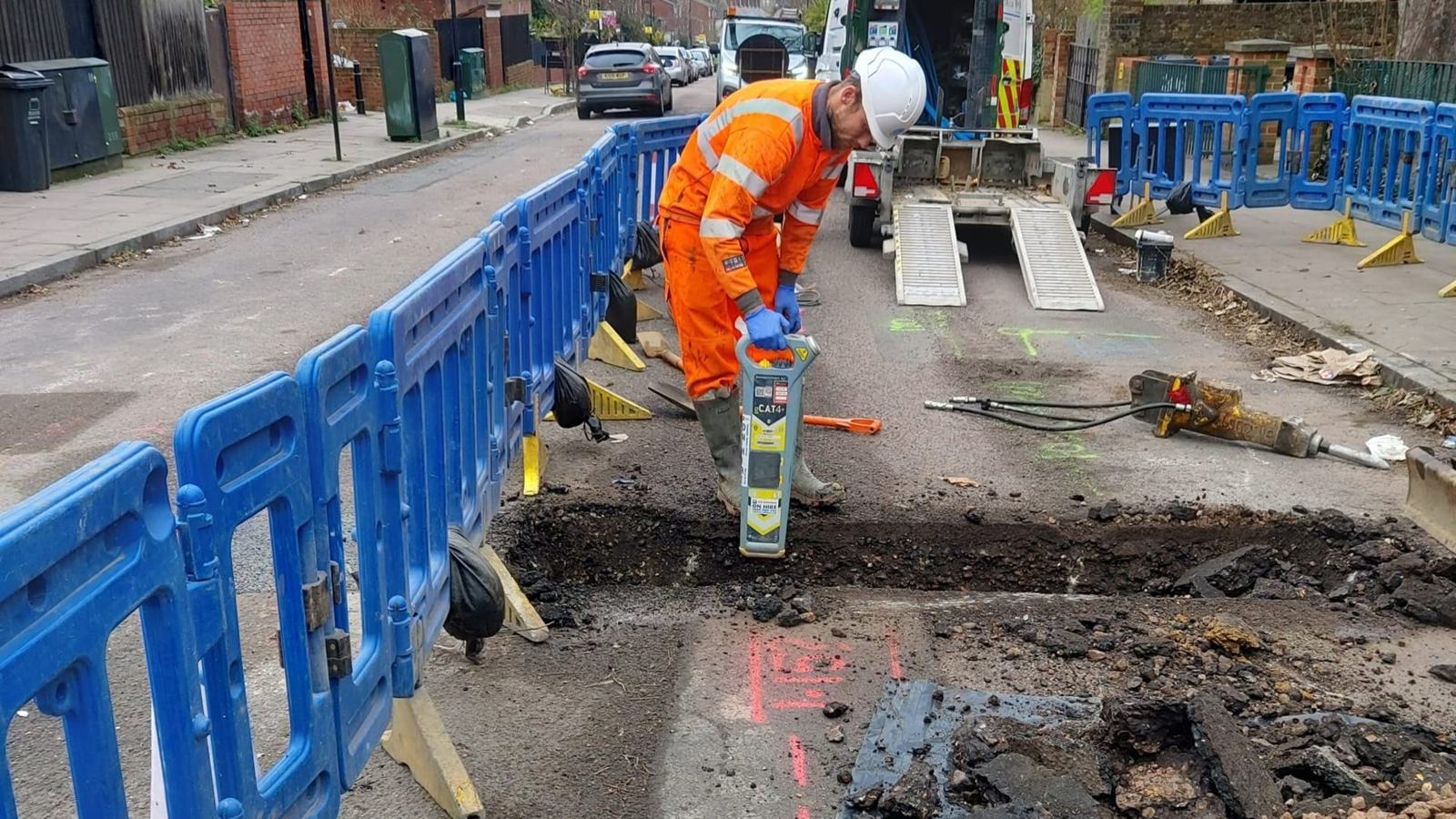
Keep scanning as you dig
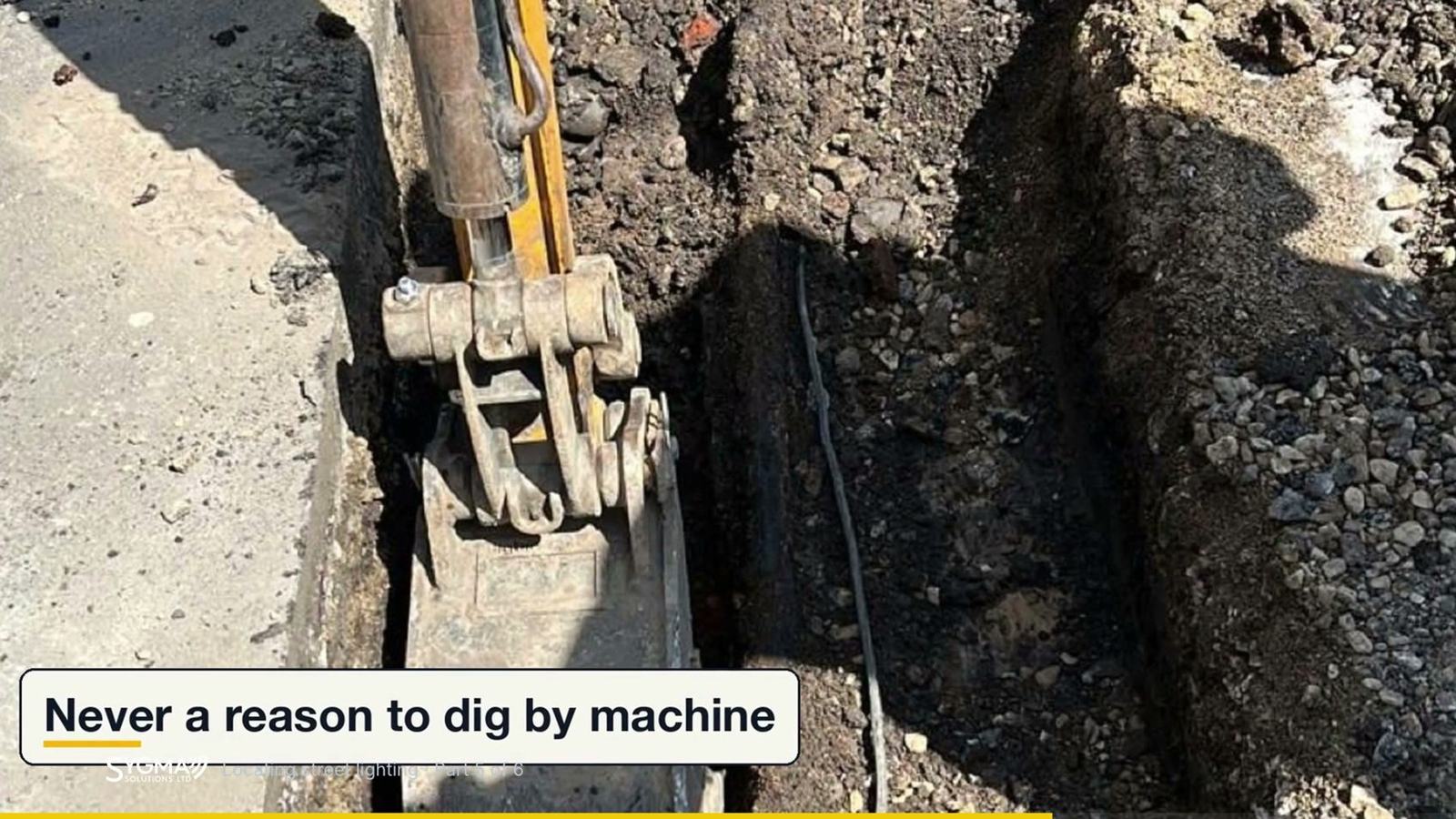
Never a reason to dig by machine
"It was shallow" isn't a root cause
When a cable gets hit, nobody can go back and bury it deeper. The question is whether it was found.
Don't take depth from the charts or plans
They are not always followed; ground levels change and things get put in wrong. A tested depth from your own Genny signal tells you far more.
08
What the manufacturers say.
From their own manuals, word for word.
| What the manual says | Radiodetection | C.Scope | Vivax-Metrotech |
|---|---|---|---|
| Never use depth to decide on digging by machine | ✓C.A.T4 guide | ✓XL4 manual, p58 | -Not stated in the guides we hold |
| Don't take depth at a bend or tee | ✓C.A.T4 guide; ABC & XYZ p59 | ✓XL4 manual, p59 | ✓vLoc3 handbook |
| Check it by lifting the locator | ✓ABC & XYZ p60: lift 0.5 m | ✓XL4 manual, p59 | ✓vLoc3 handbook: lift 0.25 m |
| A nearby line throws it out | ✓ABC & XYZ p60: up to +/- 50% | ✓XL4 manual, p59 | ✓vLoc3 handbook: congested areas |
| Not where the depth changes | ✓ABC & XYZ p60: signal steady over 10 paces | ✓XL4 manual, p59 | -Not stated in the guides we hold |
| Only accurate when conditions are right | ✓ABC & XYZ p60: 5% if suitable | ✓XL4 manual, p59 | ✓vLoc3 handbook: 5% if undistorted |
“Do not use the C.A.T4+/gC.A.T4+ depth estimation function to decide if mechanical digging over a buried conductor is appropriate.”
Radiodetection
C.A.T4 User Guide, 2026
“If the following procedure for Depth Measurement is not followed then an inaccurate depth may be indicated. This is worse than having no depth information at all.”
C.Scope
XL4 Instruction Manual, 2026, p58
“A depth reading on congested areas or close to bends or tees may be inaccurate due to distorted fields.”
Vivax-Metrotech
vLoc3 User Handbook, 2024
Radiodetection's checks for a reading that matters
"Depth measurement should be accurate to 5% if conditions are suitable. However, the user may not always know if the conditions are suitable." The ABC & XYZ of Locating, page 60.
1
Straight run
The route is straight for at least five paces either side.
2
Steady signal
The signal stays reasonably constant over those ten paces; take depths either side too.
3
No line beside it
Nothing carrying signal within three or four paces. A coupled signal "can often introduce +/- 50% error."
4
Shallowest of the set
Take several readings slightly either side of the line. "The most shallow indication will be the most accurate and will also indicate the line's position most accurately." Out of the readings you have, it is the closest, not an exact depth.
C.Scope's depth procedure, in short
1
Continuous signal
Set the transmitter to continuous, not pulsed.
2
A good signal
Best by connecting rather than induction.
3
Pinpoint
Directly over and across the line, on the ground, upright.
4
Press and hold
On a C.Scope you hold the depth button. On a C.A.T4 you tap and let go: holding gives a sonde depth, far too deep on a Genny signal.
Different on a C.A.T4
Radiodetection's own accuracy figures
+/- 10%
Locate accuracy, as a share of depth: up to 100 mm out at 1 m, 300 mm at 3 m.
5%
Depth accuracy, on a clean signal. Depth readings only work in Genny mode, on the plus models.
16% to 50%
How far distortion can push the mark out: near a 90 degree bend, or with two similar lines side by side (Radiodetection theory book).
Nobody in the industry treats an electromagnetic reading as exact: even a professional PAS 128 survey at quality level B2 is allowed to be 40% out on depth.
09
How far from the Genny, the clamp or the connection.
Too close, and the CAT picks up the signal straight through the air instead of from the cable.
| What you are doing | How far | Where it comes from |
|---|---|---|
| Start locating on induction | At least 10 m from the Genny | Radiodetection: "Move at least 10m away and use the C.A.T4 to scan for pipes and cables" (C.A.T4 User Guide, p8). ABC & XYZ: at least 10 paces. |
| A depth reading on induction | At least 25 m; we prefer 30 m | Sygma's figure. Radiodetection's C.A.T4 User Guide gives at least 10 m (p15); its ABC & XYZ says "at least 30 paces from the point of any depth measurement" (p59). C.Scope: no accurate depth "within 25 m (82') of the position of the Signal Generator/ Transmitter if used on Induction Mode". |
| A depth reading with a signal clamp | About 5 m from the clamp | Radiodetection C.A.T4 User Guide: "approximately 5m" for a clamp or direct connection (p15). |
| A depth reading with a direct connection | About 3 m from the connection | Sygma's figure. Radiodetection's guide gives about 5 m for a direct connection, as for a clamp. |
Better still, avoid depth on induction altogether. Connect or clamp, so you know what you are on.
10
In summary: training, and coaching.
01
Depth is information
Not a number to dig to. It helps you work out what is down there.
02
A failed check tells you something
A sudden change of depth, a bend, a loop, a T junction or another cable is distorting the signal.
03
Test it every time
Lift, step away, come back in, check along the line. No checks, no depth.
04
Get it with the Genny
Connected or clamped where you can. Depth only works in Genny mode.
05
Still only a guide
Hand dig, keep scanning, never decide on a machine from a depth.
06
Coaching, not just training
Depth readings are logged in the CAT data, so a supervisor or manager can see whether the checks are being done.
11
Common questions
How accurate is a CAT depth reading?
Radiodetection's C.A.T4 specification gives 5% in line mode, on a clean signal directly over the line. Near bends, tees, other cables or a sudden change of depth it can be well out, which is why we teach the checks rather than the number.
Can I get a depth in power or radio mode?
Not on a C.A.T4. Depth only works in Genny mode, and only on the plus models (C.A.T4+ and gC.A.T4+).
Why does my CAT say two metres over a service that is only 400 mm down?
Usually because the depth button was held in, not tapped. Holding it gives a sonde depth, which reads far too deep on a Genny signal.
Is StrikeAlert a depth check?
No. It only alarms at about 300 mm, gives false alarms, gives no number to test, and Radiodetection say it may not go off even over a live power cable.
Should we tell our teams not to use depth?
We'd say the opposite: teach them to test it, and coach them on it afterwards. Telling people never to use it throws useful information away.
Learn it on real streets
All of this is covered outside, on real services, on our Genny and CAT training.
Genny and CAT TrainingSources
- Radiodetection, C.A.T4 User Guide (2026) and Technical Specification (2026).
- Radiodetection, The ABC & XYZ of Locating, Part 2 Sections 3 and 6.
- Radiodetection, The theory of buried cable and pipe location, 14.6 and 14.7.
- C.Scope, XL4 Instruction Manual (2026), pages 58 and 59.
- Vivax-Metrotech, vLoc3 User Handbook (2024).
- BSI PAS 128, quality levels for utility surveys.