
Finding PME cables
Most modern house supplies use PME, delivered through a combined-neutral-and-earth (CNE) cable. To a CAT used the standard way, they are close to invisible. This page explains why, and the technique that finds them.
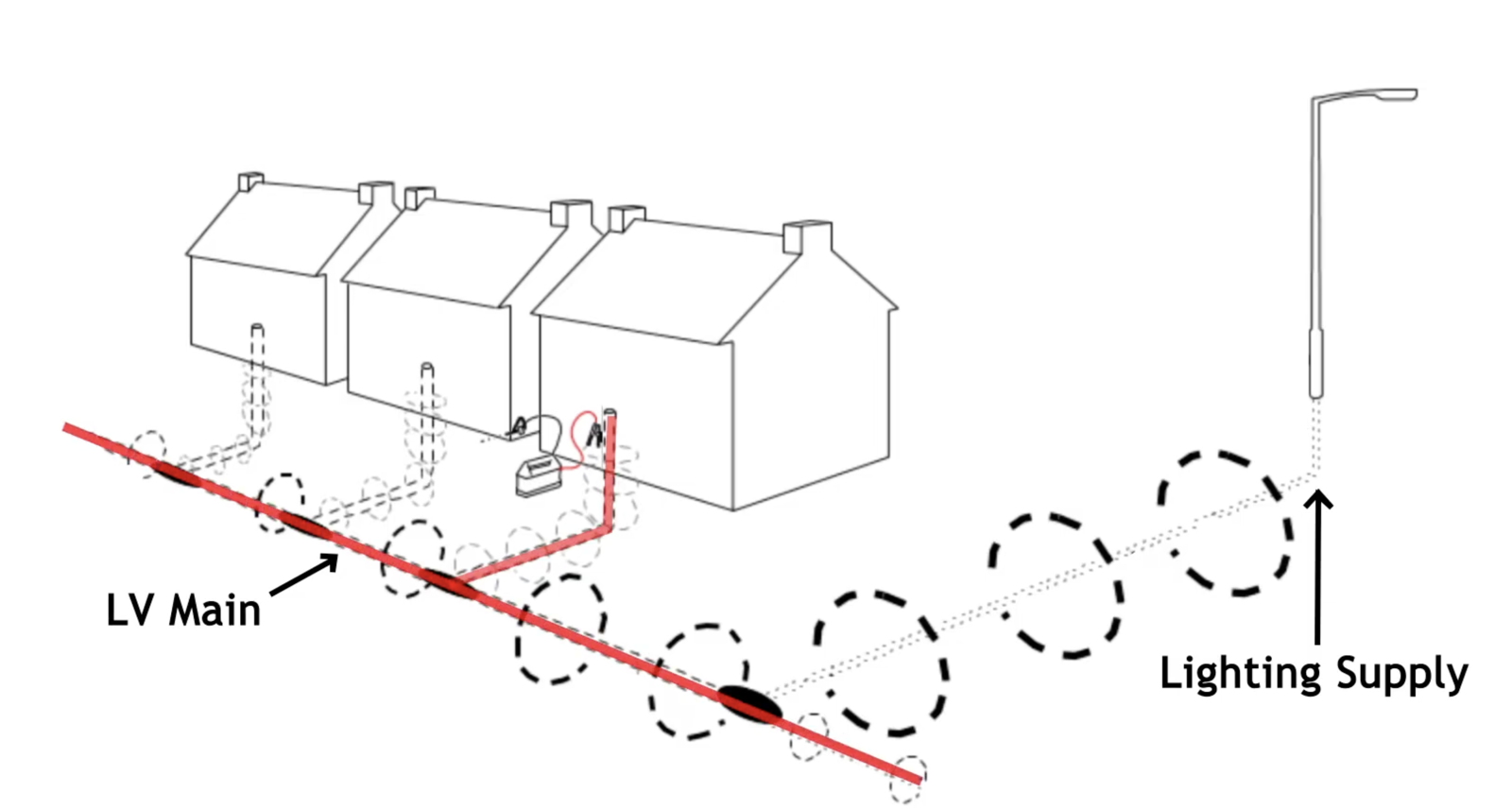
A PME house service is quiet by design: the fields that a CAT listens for largely cancel, so passive modes hear little or nothing, and a Genny signal on the main or a lamp column never sets off down the service at all.
The way to find one is a direct connection at the house, one property at a time, tracing each service back towards the main.
1The cable, and why it hides
Why some cables are built this way: the two-minute version
Years ago, most water and gas pipes were metal. The metal did two jobs: it carried the water and gas, and, without anyone planning it, it gave every house a ready-made electrical earth, because the pipe network ran into the ground everywhere.
As the utilities replaced metal mains with plastic, that free earth disappeared. Plastic does not conduct.
So the electricity network brought the earth to the house another way: inside the supply cable itself. The neutral and the earth were combined into one conductor wrapped around the live. That is PME, and a combined-neutral (CNE) cable delivers it.
Why can it be so hard to detect?
A modern house service is one of these combined-neutral cables. The current flowing out and the current flowing back share the same path, so the two magnetic fields largely cancel. Power mode listens for that field, so over a live cable of this type it hears little or nothing. A house service carrying little load in the middle of the day gives less still.1
Finding them with a Genny
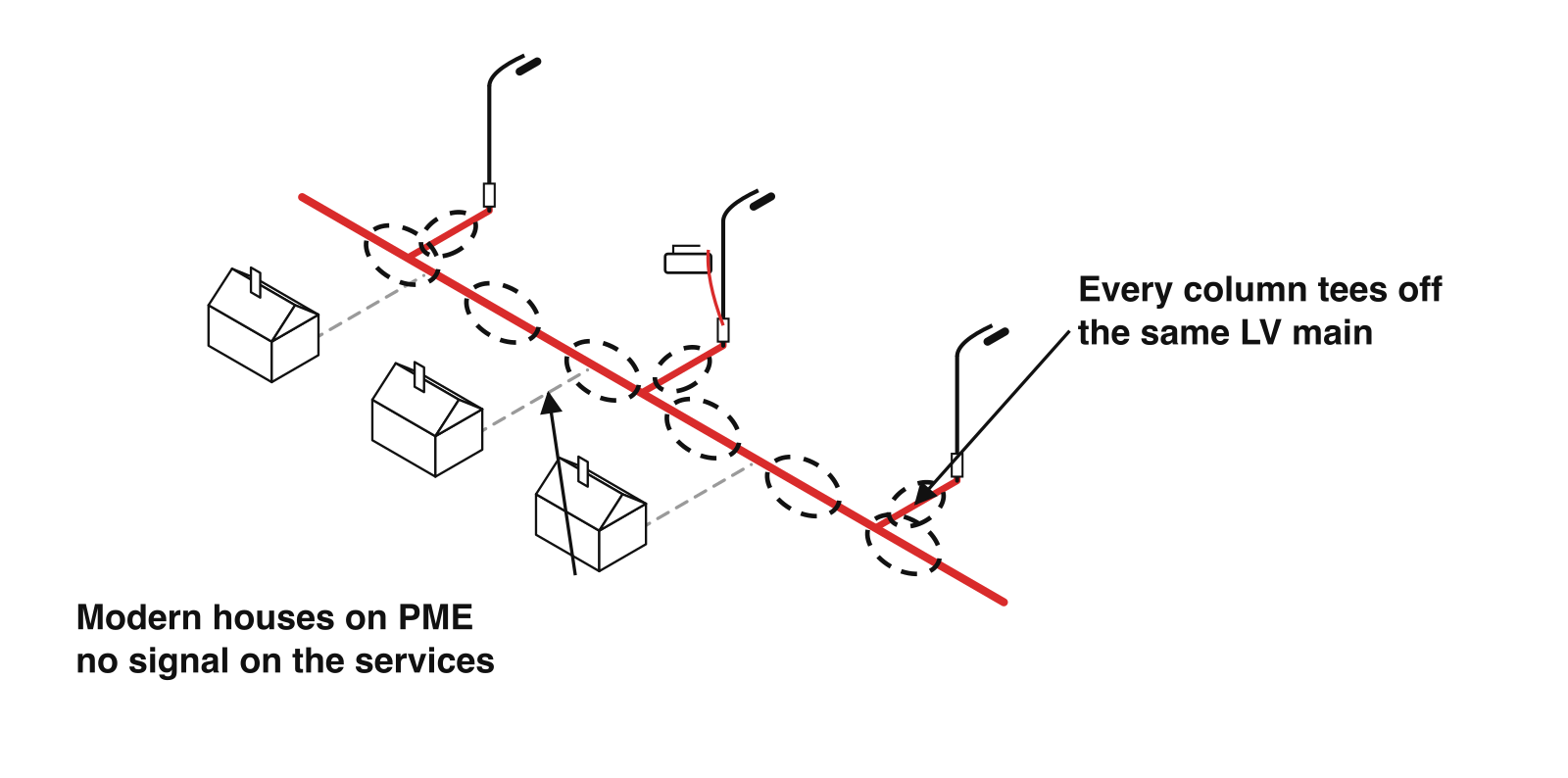
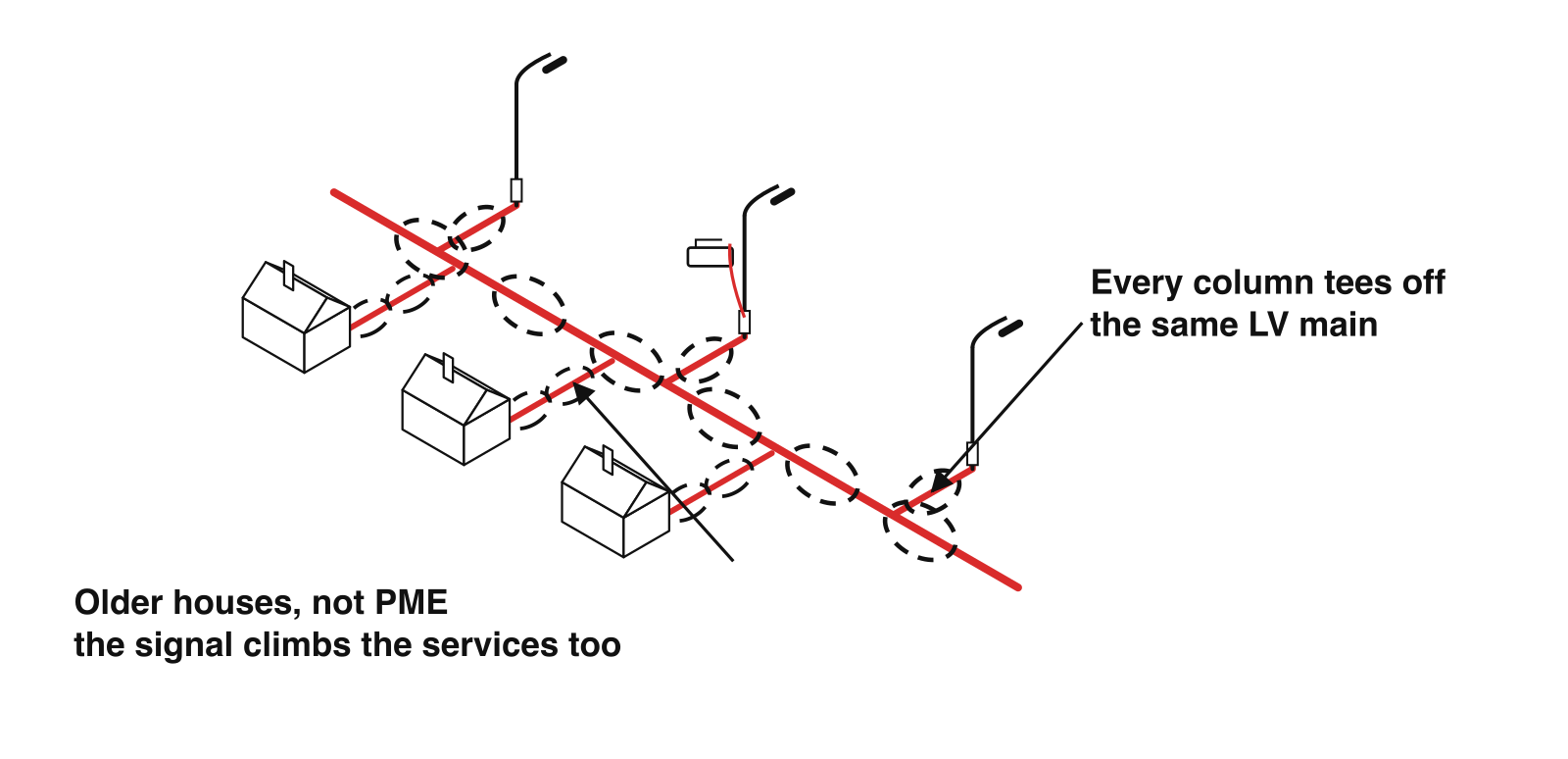
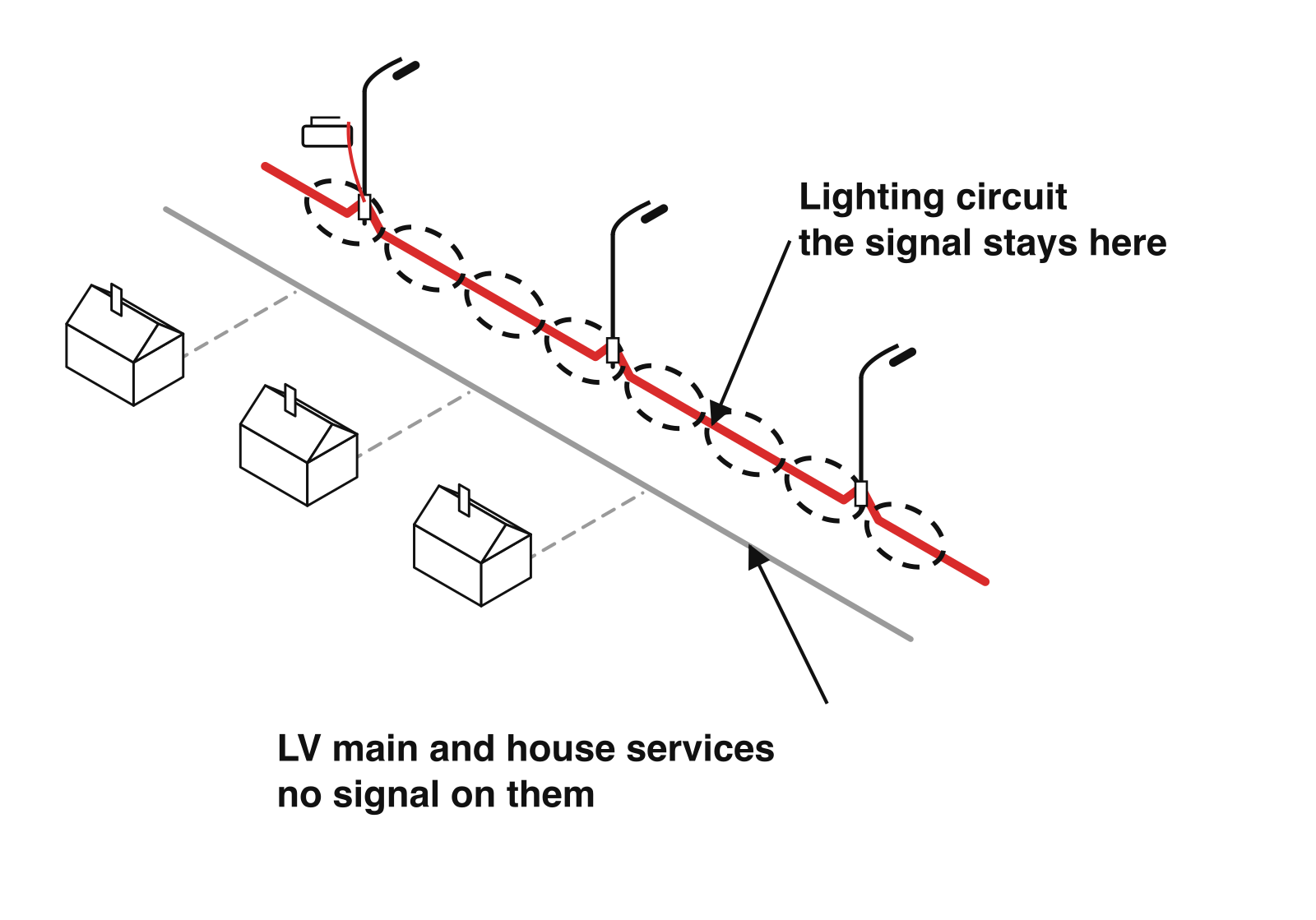
Both rely on a cable earthed at both ends. A modern house service is not, so neither gives a usable signal.3
So how do we find them?
We work in the opposite direction: rather than trying to send a signal to the property, we send a signal from the property, with a direct connection at the house. Clipped on there, the Genny puts a strong deliberate signal onto that one service,4 so it stands out from the main and can be traced back.
But it is essential to remember: connecting to one house finds that service cable and the main, and only those. The same limitation applies in reverse; the signal will not travel to any other properties. So in a street of houses on PME systems, each individual house needs to be connected to.
This is also why different streets can take drastically different amounts of time to survey correctly, and why set times cannot be expected from data downloads.
A plug-in adapter can be less effective on a combined-neutral cable,5 but the real problem is access: it needs someone at home to open the door. On a weekday, what chance every house you need is occupied? And remember, it is one connection per service, not one for the street: on a PME system a connection at one house does not light up the neighbours. When nobody answers, the connection points are on the outside of the house: an outside light, a gas riser, a tap, a doorbell, a boiler blow-off, a satellite cable run. Which point works can be trial and error: an outside tap fed in plastic may give nothing, another bonded point may work at once. Only ever connect by a method your training, the equipment manufacturer and site procedure allow, and never put a direct-connect lead on a live conductor.
2A real footpath: four of them, side by side
Everything above applies to any street of PME houses. On one footpath we surveyed recently it applied four times over. The record plan shows four service cables running the length of the footpath together, four abreast, before splitting off to the houses. All four are cables that need an individual Genny connection at the house to find.
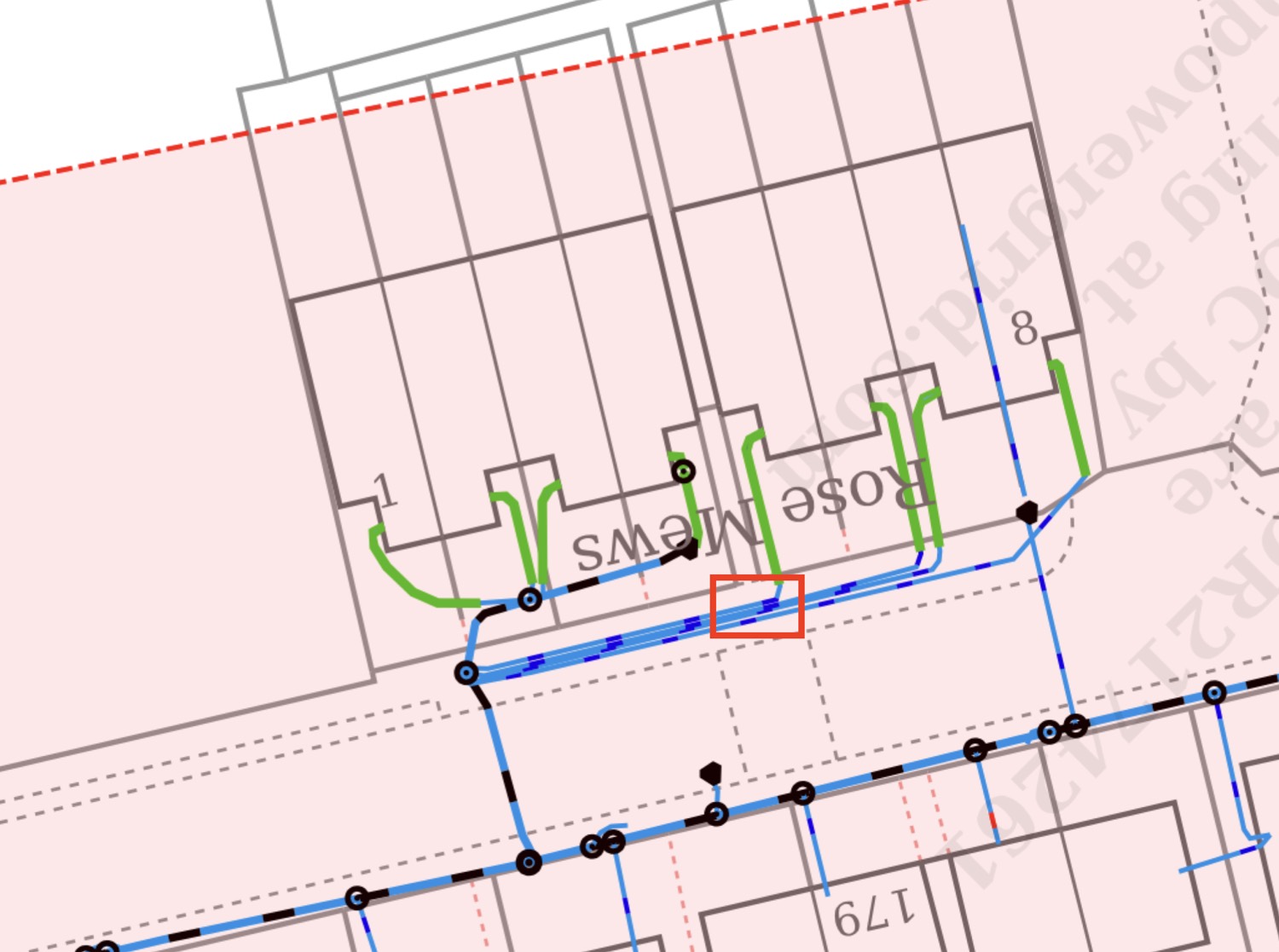
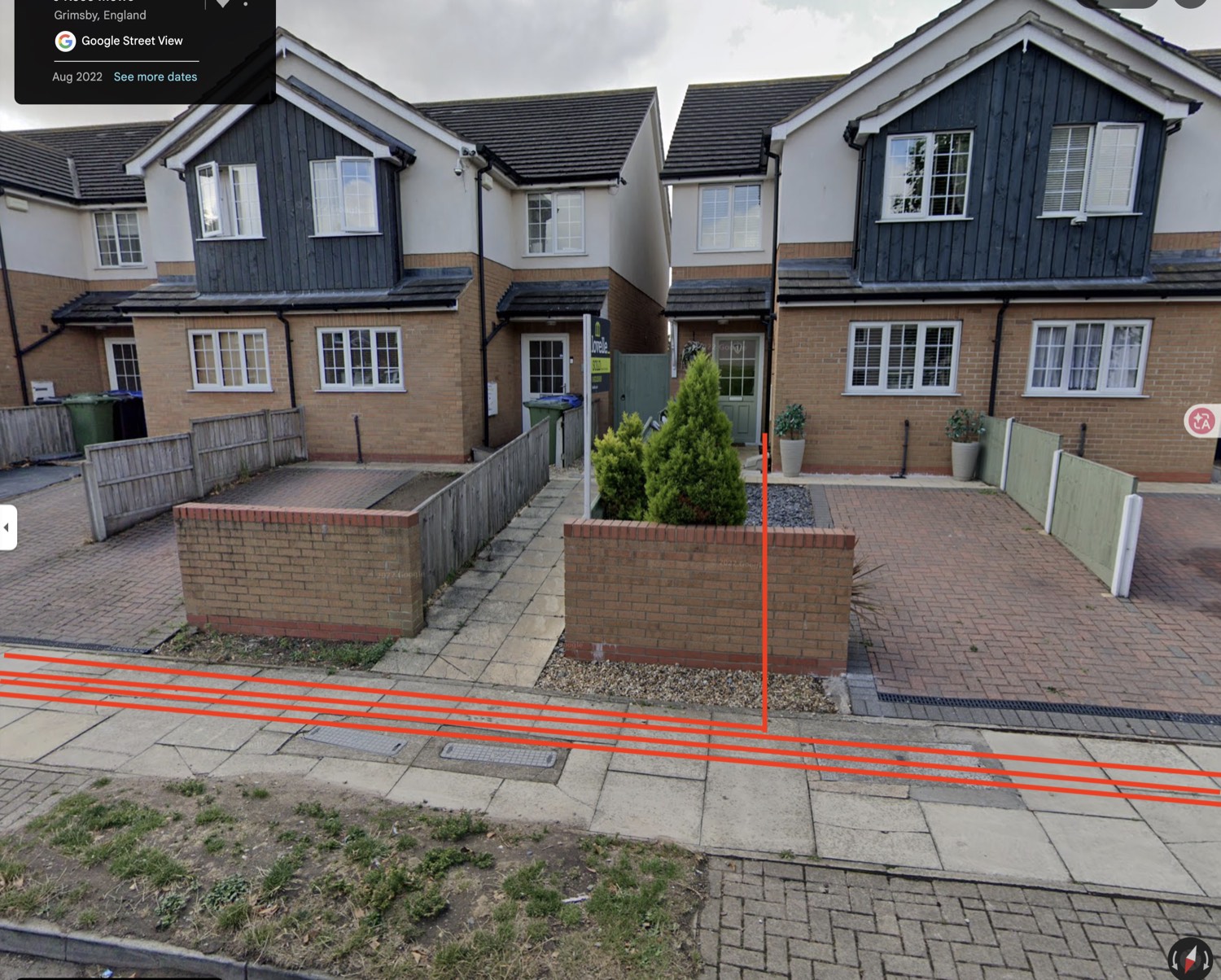
Four combined-neutral services side by side is one of the most challenging targets a CAT can be pointed at. In addition to the limitations outlined previously, there are now four tiny fields overlapping and combining, so anything a passive sweep hears is a smear, not four lines. Any signal detected in passive modes would be very distorted and in the wrong position. Some signal reaching a service is not the same as a service you can locate: the question is whether enough separate signal flows along that one cable to give a clear, correctly positioned response at ground level.6 The route to success on a footpath like this is individual house connections, not a passive sweep.
If you need to identify an individual house electricity service, get the Genny onto that property wherever it is safe and practicable, then trace the service back towards the main. A strong signal on the main does not prove the individual service is carrying enough signal to be located.
3The finer print
The detail behind the numbered points above, for anyone who wants the electrical reasoning rather than the working method.
- Why the cable is quiet. In a CNE service cable the live runs through the centre and the combined neutral and earth, the PEN conductor, surrounds it. Current out and current back are carried very close together, their fields oppose, and much of the field outside the cable cancels. Power mode detects that field, not voltage, so a live cable is not automatically a detectable one, and a house drawing little power gives less field still. back
- Protective earth is not a ground connection. A PME property does have a protective earth, and it comes back through the PEN conductor. What it does not necessarily have is an independent physical connection into the ground at the property end. That is the difference a Genny cares about, because its current has to complete a circuit. back
- Radio, induction and capacitive coupling. Some current can couple to ground through the buried length of a cable, so nothing at all is rarely literally true. On a short house service with no useful ground at the far end, what does couple is usually far too weak to locate on. back
- Where the signal actually goes. The Genny current divides between the paths available and more of it takes the easier one. The street main sits in a large, multiply earthed network; a short service ending at a house with no independent ground connection is a much poorer path. That is why the main can ring while the service beside it stays quiet. back
- Why a plug-in adapter can struggle here. A plug-in connector applies the signal between live and earth. On a PME property that earth returns through the PEN, which in a CNE cable surrounds the live. The outgoing and returning signal currents are then as closely spaced as the power currents, and the external field can cancel for the same reason. back
- Enough signal, not any signal. The CAT reads the field at ground level. If a service is half a metre down and a nearby main is carrying far more signal, the weak field from the service can be swamped. The question is never whether some signal reached it, but whether enough separate signal is flowing along that one cable. back
4Common questions
Why can a CAT miss a modern house electricity service?
Most modern house supplies use PME, delivered through a combined-neutral-and-earth (CNE) service cable. In it the live runs through the centre and the combined neutral and earth surrounds it, so the current out and the current back are carried very close together and their magnetic fields largely cancel. Power mode listens for that field, so over a live cable of this type it hears little or nothing, and a house service carrying little load in the middle of the day gives less still.
Will a Genny signal on the main or a lamp column reach a house service?
No. The signal is a current, and current only flows where it can make a round trip: out along a cable, back through the ground. A modern house service has a protective earth through the PEN conductor but no independent ground connection at the property end, so there is no way back and the signal never sets off down the service at all. Radio mode and induction fail for the same reason: both rely on a cable earthed at both ends.
How do you find a PME house service with a Genny?
Work in the opposite direction: send the signal from the property with a direct connection at the house. Clipped on there, the Genny puts a strong deliberate signal onto that one service, so it stands out from the main and can be traced back. A connection at one house does not light up the neighbours, so each house needs its own connection. When nobody is home to let you in, the connection points are on the outside of the house: an outside light, a gas riser, a tap, a doorbell, a boiler blow-off, a satellite cable run.
Why do some streets take much longer to survey than others?
Because each PME service needs its own individual house connection. A footpath carrying several combined-neutral services side by side can only be surveyed correctly one connection at a time, which is why different streets take drastically different amounts of time and why set times cannot be expected from data downloads.
Locating PME and combined-neutral services when lack of access prevents a plug-in adapter is not part of the standard CAT 1 training specification. It is covered on our utility detection courses and in the Genny-first methodology.