Course Agenda
One-day course outline · the day that follows day one
Utility Location in Practice
ULP course · Genny and CAT
 Written forSevern Trent Water · tailored to your permits, risk assessments and re-scan rule
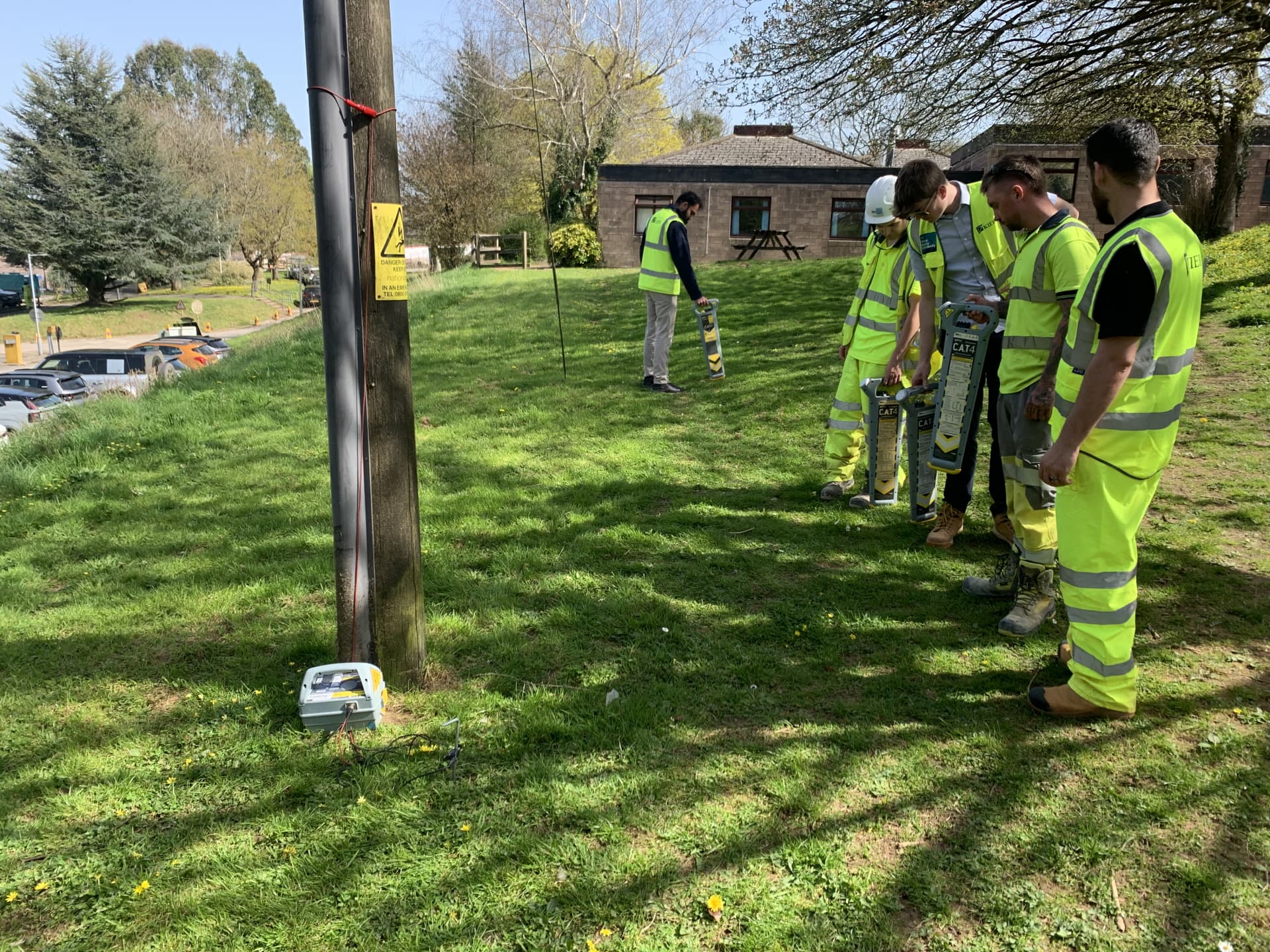
The second-stage day for people who already hold the one-day Genny and CAT course. Almost all of it is spent outside, on two deliberately different types of street, working each one as a survey from start to finish. Every delegate is assessed individually.
Duration
One day
09:00 – ~15:00
Group size
Max 8
Per trainer, per day
Delivery
On-site UK-wide
or our Wigan centre
Assessment
Individual
Every delegate, on site
Accredited & approved by


Prerequisite: each delegate must already hold the Sygma one-day Genny and CAT course — whichever certificate route they took, in-house or EUSR registered. This course builds directly on that day and assumes it.
Why this is a different course, not a repeat
The classroom shrinks
The consequences of a strike, the videos and the paperwork were covered on day one. They are not covered again. The classroom here exists only to set up the practical.
Two streets, not one
The two practicals are run in deliberately different environments — an older network and a newer one — so the method has to transfer rather than the site being learned.
Everyone is assessed
Individual assessment at the end of the day, on site, against what was taught. Not a group exercise, and there is no written paper.
Course objectives
Stop scanning holes. Start surveying streets.
By the end of the day, every delegate will be able to:
- ✓Work a street as a survey rather than scanning a hole
- ✓Read the surface for what has to be underneath it, before touching the kit
- ✓Ask where every visible asset gets its feed from, and prove the answer
- ✓Apply a signal every way the job allows — direct connection, clamp, capacitance and induction
- ✓Connect at a lighting column, at a property, and at an exposed service, and confirm the signal has taken
- ✓Exhaust connection before induction, and active before passive
- ✓Run a blind induction sweep, null out a service, and check for airborne signal
- ✓Pinpoint, trace, mark, and check depth two ways
- ✓Trace a service that turns out not to cross the dig, and treat that as a result
- ✓Recognise when a suspected service has not been found, and stop
- ✓Read your own recorded data and see what it says about how you worked
- ✓Know honestly what the equipment will not find, and what to do then
In the classroom · the short half
Only what the practical needs
Roughly a third of the classroom time of the initial course. Everything here exists to make the two practicals land — nothing is repeated for the sake of covering it again.

What the data says about us
Opens the day
The day starts on real recorded data rather than theory, because it is what earns the rest of it.
- What a CAT download actually records, beyond the coloured dashboard
- Mode order — what starting in power rather than Genny tells you
- Connection against induction, and the difference in the record
- What an idle trigger looks like, and why time on its own proves nothing
- Reading your own team's data rather than an example

The survey, not the hole
The core change
The single habit this course exists to change: thinking from the street inwards rather than from the excavation outwards.
- Why a metre-by-metre scan of the dig answers the wrong question
- Planning the survey from the plans and the street before the kit comes out
- Proving a service does not cross the excavation, and why that is time well spent
- What to do when the plans and the ground disagree

Visual surveys — thinking outside the box
Practical-led
Every visible asset is fed by something. A lamp column, a bollard, a meter box, a house — each one is telling you a cable is there, and roughly where it has to run.
- Where does that get its power from? Working backwards from what you can see
- Reading a street: columns, bollards, meter boxes, joint boxes, covers, reinstatement scars
- The outlier — an asset on the far side of the road, and what that means for the crossing
- Building the list of what should be there before deciding what has been found
- Worked street scenes, start to finish
Your own documents
Tailored
Generic paperwork replaced with yours, so the day matches the job the delegates go back to.
- Your permit to dig, and where it sits in your safe system of work
- Your site-specific risk assessments
- Your own rule on how far may be excavated before re-scanning
- Your reporting and escalation route when something cannot be found
On the ground · most of the day
Most of the day is on the ground
Every Genny application, every tracing and depth technique, worked on real streets rather than demonstrated. Run across two contrasting environments with a break between them to go over what each pair found, so the method has to transfer rather than the site being learned.
Exactly what is available varies by site, so the two locations are agreed with you when the course is booked.

Transmitter (Genny) applications
Every way to apply a signal, and how to confirm it has actually taken. This is the heart of the day and the most time is spent here.
- Direct connection to a known utility, correct earthing, confirming the connection and the signal
- Signal to a street-light cable by direct connection — correct technique and distance
- Signal to a domestic LV service at a property or building
- High-frequency signal using a capacitance technique
- Signal applied using the signal clamp — correct technique and distance
- Induced signal to a known target — correct technique and distance
- Blind induction sweep in two directions across a site
- Nulling out a buried utility
- Checking for airborne signal in every inductive application
Locating — pinpointing, tracing, depth
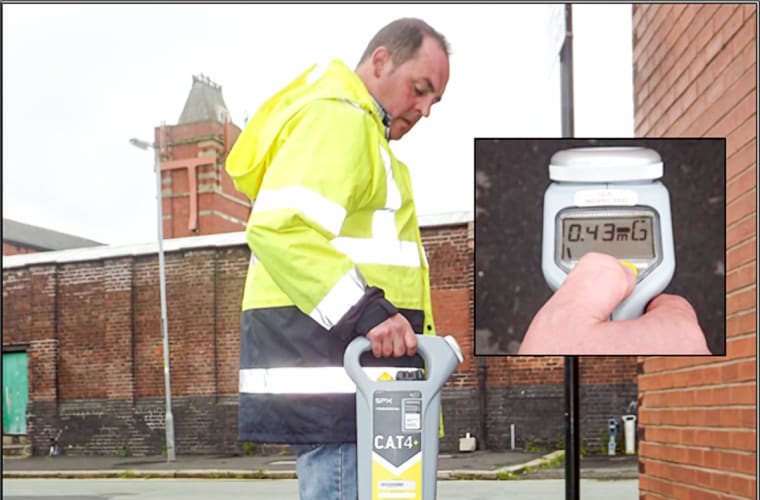
Turning a signal into a marked, traced, depth-checked line on the ground.
- Controlling sensitivity to locate, then pinpoint
- Determining direction, tracing with the correct technique and marking the position
- Identifying sudden signal loss and explaining why it occurs
- Locating a joint — T-connection or bend
- Recognising being too close to the transmitter, and correcting erratic sensitivity
- Depth estimates at the correct distances, knowing when depth is unreliable, and checking it two ways

Technique and strategy across the site
The judgement that separates a competent operative from someone pressing buttons.
- Using the plans to apply the transmitter signal in the best place throughout the survey
- Transmitter first — exhausting connection before induction, and active before passive
- The limitations of induction, why the signal is not selective, and when to run a blind sweep
- Dual-frequency transmitters and the benefits of each frequency
- The limitations of locating HV cables, and inducing a signal to find them
- Continuously scanning as the excavation progresses, and why
- Strike Alert — what it is for and how to disable it

Passive — power and radio
Catching what an applied signal cannot. Last, never first.
- Power survey using the sensitivity control appropriately and the correct search technique
- Radio survey using the sensitivity control appropriately and the correct search technique
- Why passive comes at the end of the survey and never at the start
The two environments
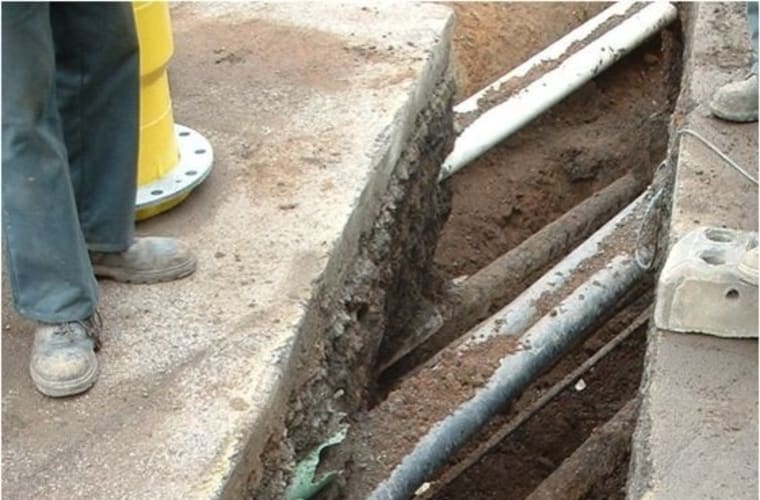
The practical is run across two contrasting types of street, so the method has to transfer rather than the site being learned.
- An older network — shared ducts, lighting fed off the main, services that pre-date the drawings
- A newer network — PME systems where a signal at the main will not reach the property
- Connecting at the property: gas meter, boiler blow-off, outside light, without knocking on a door
- Small moulded services, and why they carry so little of the signal
- Plastic gas and pot ends — being honest about what will not be found
- Exact locations depend on the venue and are agreed with you before the day
Assessment
Every delegate, individually
The day closes with an individual practical assessment. Each delegate works a short survey on their own, against what has been taught, and is assessed on the method rather than on whether they happen to find a particular cable.
- ✓Worked alone, on site, at the end of the day
- ✓Assessed on the survey method — plan, look, connect, trace, prove
- ✓Their own recorded data reviewed with them as part of it
- ✓Clear pass or referral, with what to work on either way
- ✓A referral means further support, not a failed ticket — the qualification already held is unaffected

Talk to us about running ULP
We tailor the classroom section to your own permits, risk assessments and re-scan rule, and agree the two practical locations with you before the day.
Get in touch →