
Sygma/Clancy Genny & CAT1
How this course compares with the EUS Category 1 standard
✓Proof of equivalence with EUS Category 1, and where the course goes beyond it
This document covers
This document shows how the Sygma/Clancy Genny & CAT1 course, developed exclusively for The Clancy Group and endorsed by EUSR, covers every assessment criterion in the EUS Category 1 specification, goes beyond it in a number of places, and still comes with the EUS card as normal.
EUS criteria
28
every one met
EUS assess practically
21
7 are written only
Beyond the standard
30
no criterion requires them
Certificate
EUS card
as normal
Accredited & approved by


Client guide
Confirmation of equivalence with EUS Category 1
Clients commonly ask for EUS Category 1 or equivalent at pre-qualification. This document answers that from the standard itself.
Every criterion is quoted exactly as EUSR wrote it, in their order and numbering, with the assessment method they set against each. All 28 are met. EUSR require 21 of them to be demonstrated practically and allow 7 to be answered in writing.
Part one maps the course against every criterion. Part two lists the 30 items it covers that no criterion requires. Part three compares the practical assessment.
The two courses
The standard
EUS Category 1: Locate Utility Services (HSG47)
Scheme Specification v1.0, 2025
The course
Sygma/Clancy Genny & CAT1
EUSR-endorsed programme, built for Clancy
Practical requirements from EUSR's Category 1 Practical Assessment Observation Record v1.0. Delivery rules from Scheme Handbook V3.0, November 2025.
Part one
Every EUS Category 1 criterion, mapped against Sygma/Clancy Genny & CAT1
EUSR's wording, unedited. The criterion numbers are theirs.
Be able to plan for the location of underground services
| EUS Category 1: Locate Utility Services (HSG47)Scheme Specification v1.0, 2025 | Sygma/Clancy Genny & CAT1EUSR-endorsed programme, built for Clancy | |||
|---|---|---|---|---|
| # | Assessment criterion, as written by EUSR | Assessed by | Met? | What we do |
| 1 | Interpret plans/maps in accordance with instructions | Practical | ✓ | Assessed on the ground, using the drawings for the site we are standing on rather than a generic exampleOn the ground |
| 2 | Identify plan references and symbols | MCQ/Practical | ✓ | Assessed. Plans from every provider, including keys, symbols and colour codesOn the ground |
| 3 | Explain potential safety considerations and control measures when carrying out a risk assessment | MCQ/Practical | ✓ | Covered and assessedOn the ground |
| 4 | Carry out a site-specific risk assessment and establish a safe working zone | Practical | ✓ | Assessed, recorded on the point of work risk assessmentOn the ground |
Be able to prepare resources to locate and identify services
| EUS Category 1: Locate Utility Services (HSG47)Scheme Specification v1.0, 2025 | Sygma/Clancy Genny & CAT1EUSR-endorsed programme, built for Clancy | |||
|---|---|---|---|---|
| # | Assessment criterion, as written by EUSR | Assessed by | Met? | What we do |
| 5 | Identify the features of a typical Safe System of Work | MCQ | ✓ | Covered |
| 6 | Check appropriate PPE is free from damage, fit for purpose and available for use | Practical | ✓ | AssessedOn the ground |
| 7 | State potential contingencies and personal actions if unforeseen events or emergencies occur | MCQ | ✓ | Covered |
| 8 | Explain the roles and responsibilities of individuals involved in the work site operation | MCQ | ✓ | Covered |
| 9 | Identify appropriate resources and equipment required to carry out location and marking work safely | MCQ/Practical | ✓ | AssessedOn the ground |
| 10 | Check that a safe working zone exists and is appropriately protected with barriers and signs | Practical | ✓ | AssessedOn the ground |
| 11 | State the action to take if equipment is found to be defective or damaged | MCQ | ✓ | Covered |
| 12 | Complete a visual assessment of the location equipment and explain how you record any defective finding | Practical | ✓ | AssessedOn the ground |
| 13 | State the potential consequences if damaged or faulty equipment is used | MCQ | ✓ | Covered |
| 14 | Demonstrate all the pre-use checks on the location equipment to be used, in accordance with the specific manufacturer’s instructions | Practical | ✓ | Assessed as two separate checks, a function check and an in-service date checkOn the ground |
Know how to locate, detect and mark different underground services
| EUS Category 1: Locate Utility Services (HSG47)Scheme Specification v1.0, 2025 | Sygma/Clancy Genny & CAT1EUSR-endorsed programme, built for Clancy | |||
|---|---|---|---|---|
| # | Assessment criterion, as written by EUSR | Assessed by | Met? | What we do |
| 15 | Check that all necessary preparatory work has been completed correctly, prior to work commencing | Practical | ✓ | AssessedOn the ground |
| 16 | Explain how different modes operate and their limitations | MCQ/Practical | ✓ | Covered, plus a session of its own on what the kit genuinely cannot findOn the ground |
| 17 | Demonstrate how to use the location equipment to detect and locate underground services | Practical | ✓ | Assessed, and broken into separate elements: control sensitivity, pinpoint, determine direction, trace and markOn the ground |
| 18 | Explain the limitations and challenges posed by specific types of underground services | MCQ | ✓ | Covered |
| 19 | Outline the advantages and disadvantages of using Ground Penetrating Radar as an additional piece of location equipment | MCQ | ✓ | Covered |
| 20 | Explain the importance of marking up signals detected and the variety of marking materials that can be used | Practical | ✓ | AssessedOn the ground |
| 21 | Identify any control measures needed to mitigate risks associated with location activities | MCQ/Practical | ✓ | Covered and assessedOn the ground |
| 22 | Demonstrate how both Parallel Sweeps and Radial Sweeps can be beneficial | Practical | ✓ | AssessedOn the ground |
Be able to carry out location work in accordance with health, safety and environmental legislation, regulations, company policies and procedures (industry best practice)
| EUS Category 1: Locate Utility Services (HSG47)Scheme Specification v1.0, 2025 | Sygma/Clancy Genny & CAT1EUSR-endorsed programme, built for Clancy | |||
|---|---|---|---|---|
| # | Assessment criterion, as written by EUSR | Assessed by | Met? | What we do |
| 23 | Select appropriate mode required for initial sweep of the designated excavation area to locate a potential power cable shown on the site plan | Practical | ✓ | Assessed, following a visual survey of the site carried out as its own assessed disciplineOn the ground |
| 24 | Carry out locating and sweeping of the area to confirm underground services located | Practical | ✓ | AssessedOn the ground |
| 25 | Interpret correctly results shown by the location equipment | Practical | ✓ | AssessedOn the ground |
| 26 | Demonstrate the use of all available modes to locate another type of buried service shown on the plan | Practical | ✓ | Assessed, and broken into nine separately assessed applications rather than one demonstration. Listed belowOn the ground |
| 27 | Demonstrate the use of appropriate marking methods and materials to indicate the location of different services | Practical | ✓ | AssessedOn the ground |
| 28 | Record and report any unexpected findings, both prior to work starting and throughout the location activity | Practical/MCQ | ✓ | AssessedOn the ground |
Part two
What Sygma/Clancy Genny & CAT1 adds
30 things delivered on the Sygma/Clancy Genny & CAT1 course that no EUS Category 1 assessment criterion requires. Where something is named in EUSR's guidance as an example but is not itself assessed, it says so.
Applying a signal
| ✓ | Direct connection to a street light cable, correct technique and distanceOn the ground | The specification names street lighting only once, as a limitation of power mode. It never asks for a signal to be applied to one. |
| ✓ | Direct connection to a domestic LV service at a propertyOn the ground | Meter boxes and cable entry points appear only in the visual site assessment. Connecting to a house service is not required. Added to our practical assessment sheet in August 2026. |
| ✓ | Confirming the connection and that the signal has actually takenOn the ground | The specification requires the signal to be applied, not confirmed. |
| ✓ | Correct earthing on a direct connectionOn the ground | Not named anywhere in Category 1. |
| ✓ | Blind induction sweep in two directions across a siteOn the ground | Induction is required. A blind sweep, in two directions, is not. |
| ✓ | Nulling out a buried utility to find what sits next to itOn the ground | The modes listed in the specification are power, radio, signal generator and Avoidance or All Scan. Nulling out is not among them. |
| ✓ | Checking for airborne signal on every inductive applicationOn the ground | Not named anywhere in Category 1. |
| ✓ | Signal clamp, correct technique and distanceOn the ground | Named in the Supporting Information as an example of applying a signal. No assessment criterion requires it to be demonstrated.Guidance only, not an assessed criterion |
| ✓ | High frequency capacitance, the wrap around methodOn the ground | Named in the Supporting Information as an example. No assessment criterion requires it to be demonstrated.Guidance only, not an assessed criterion |
| ✓ | Three pin plug adaptorOn the ground | Named in the Supporting Information as an example. No assessment criterion requires it.Guidance only, not an assessed criterion |
Locating
| ✓ | Locate a joint, T-connection or bendOn the ground | Not named anywhere in Category 1. |
| ✓ | Identify sudden signal loss and explain why it happensOn the ground | Not named anywhere in Category 1. |
| ✓ | Recognise being too close to the transmitter, and correct erratic sensitivityOn the ground | Not named anywhere in Category 1. |
| ✓ | Depth checked two ways to confirm the readingOn the ground | The specification covers depth awareness and depth estimation, but never asks for the reading to be confirmed by a second method. |
| ✓ | Depth estimates taken at the correct distancesOn the ground | Depth estimation appears in the guidance only. Not one of the 28 assessment criteria mentions depth.Guidance only, not an assessed criterion |
| ✓ | Knowing when a depth reading is unreliableOn the ground | Depth uncertainty appears in the guidance only. No criterion assesses it.Guidance only, not an assessed criterion |
Strategy
| ✓ | Shallow cable alert: what it is for and how to disable it | Listed in the guidance as a locator-specific feature. No criterion assesses it.Guidance only, not an assessed criterion |
| ✓ | Continuously scan as the excavation progresses | Repeated detection sweeping appears in the guidance. No assessment criterion covers what happens once digging starts.Guidance only, not an assessed criterion |
| ✓ | Transmitter first: exhaust every connection option before induction, all active modes before passive | The specification notes passive modes may be insufficient, but sets no order of preference to work to. |
| ✓ | Dual-frequency transmitters and the benefit of each frequency | The specification mentions scanning all frequencies at once, not choosing between two. |
Recording
| ✓ | Data logging and C.A.T. Manager, so usage can be reviewed and evidenced afterwards | Data enabled locators appear in the guidance. No criterion requires recorded data to be produced or read.Guidance only, not an assessed criterion |
Consequences
| ✓ | What actually happens when a service is struck, service by service | The consequences of striking power, gas, water, sewers and fibre appear in the Supporting Information. No assessment criterion tests any of it. We teach it with real damage examples.Guidance only, not an assessed criterion |
| ✓ | HSG47, the wider regulations and company policy | HSG47 is named in the guidance and in the category title. No assessment criterion requires the guidance itself to be known.Guidance only, not an assessed criterion |
Plans
| ✓ | PAS128 drawings, and how a PAS128 survey differs from a STATS plan | PAS128 does not appear anywhere in Category 1 of the 2025 specification. |
| ✓ | Line search documents | Removed from the standard at the 2025 review. We kept it. |
| ✓ | Permit to dig: what it is for, and what it does and does not authorise | Permits to Work appear in Category 2, not Category 1. |
Assessment
| ✓ | Five practical disciplines, each assessed individuallyOn the ground | The specification requires the practical criteria to be met. It does not require them to be broken out and signed off separately. |
| ✓ | The delegate signs the practical assessment sheet | Not a scheme requirement. Signed on the day, in front of the trainer, confirming every element was actually covered. |
Delivery
| ✓ | More than half the day spent hands-on | The scheme sets a six hour minimum for the day but no split between classroom and practical. |
| ✓ | Built around Clancy procedures, methods of work and client requirements | The specification asks for company policy to be covered. It does not produce a course written for one client. |
Part three
The practical assessment compared
EUSR set out the whole of what a Category 1 practical must contain in their Practical Assessment Observation Record. This is that list, in their words, against what a delegate actually gets on Sygma/Clancy Genny & CAT1.
| EUS Category 1: Locate Utility Services (HSG47)Minimum practical requirement | Sygma/Clancy Genny & CAT1What the delegate gets |
|---|---|
| A safe and protected area of ground containing a minimum of three different services (e.g. Gas, Power, Water etc.) with one being a live power cable | A live site with numerous buried metallic utilities. One cable to a cabin is explicitly not enough, and it is a stated host site requirement |
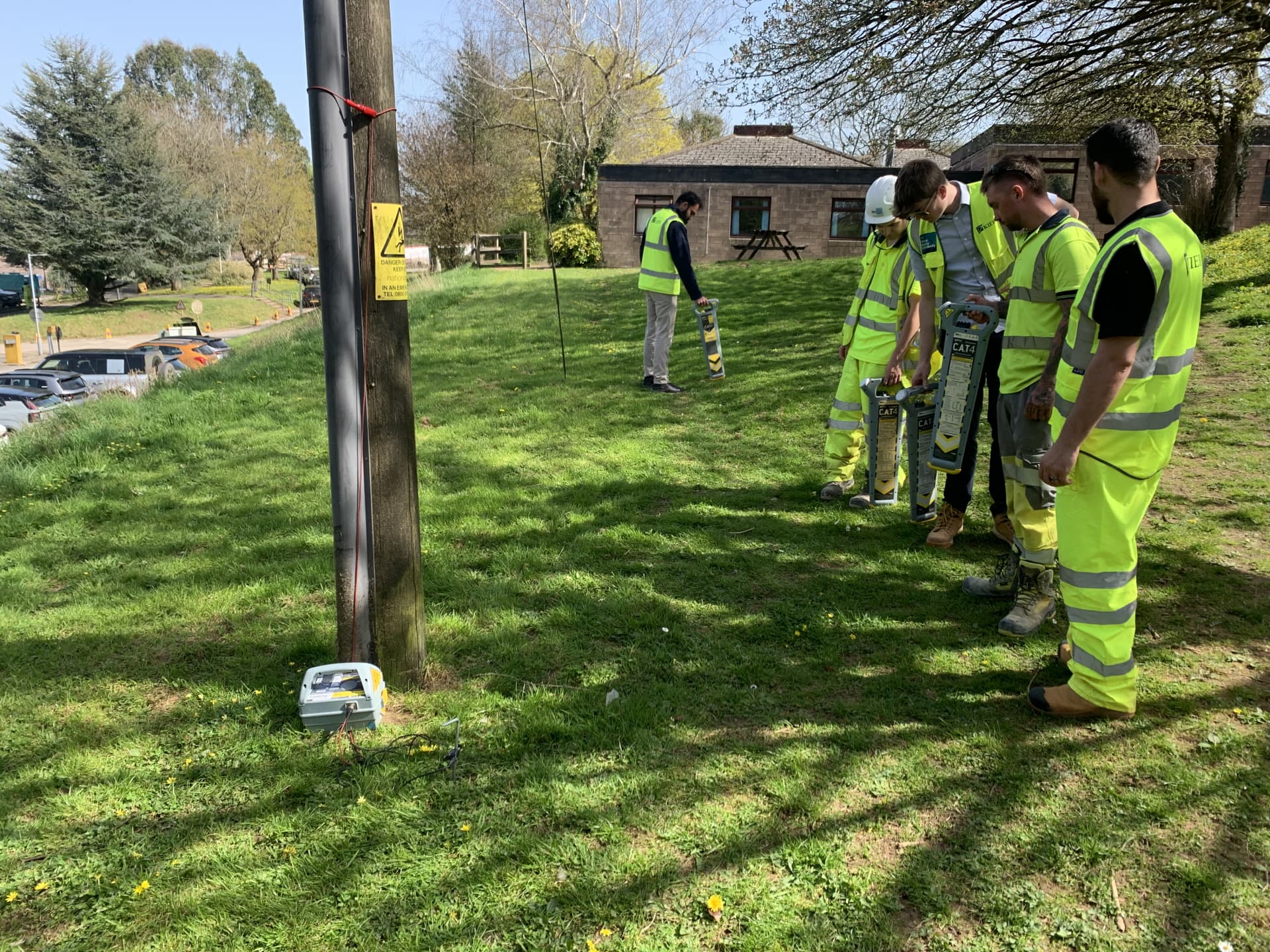
| Recognised location equipment capable of detecting electromagnetic signals either from live power cables, or induced by the equipment generator | Genny4 and C.A.T.4+ brought by Sygma, enough for the whole group, and delegates encouraged to bring their own kit |
| At least two types of marking materials | Marking materials appropriate to the ground and weather on the day |
| A range of site plans showing symbols, colour codes and other relevant information | STATS plans for the actual practical site, supplied free by Sygma |
| Blank site-specific Risk Assessment forms | Point of work risk assessment completed by the delegate on the day |
| The individual provides oral explanations of various aspects of the planning and preparatory steps | Explanations still required, but the planning and preparatory steps are also carried out and observed |
| The Assessor must use oral questioning during the practical assessment, undertaking a holistic assessment | Oral questioning throughout, plus five separately assessed disciplines rather than one holistic judgement |
Related document
The full course agenda
The classroom theory, the five practical disciplines, what the host site needs to provide and how the assessment works.