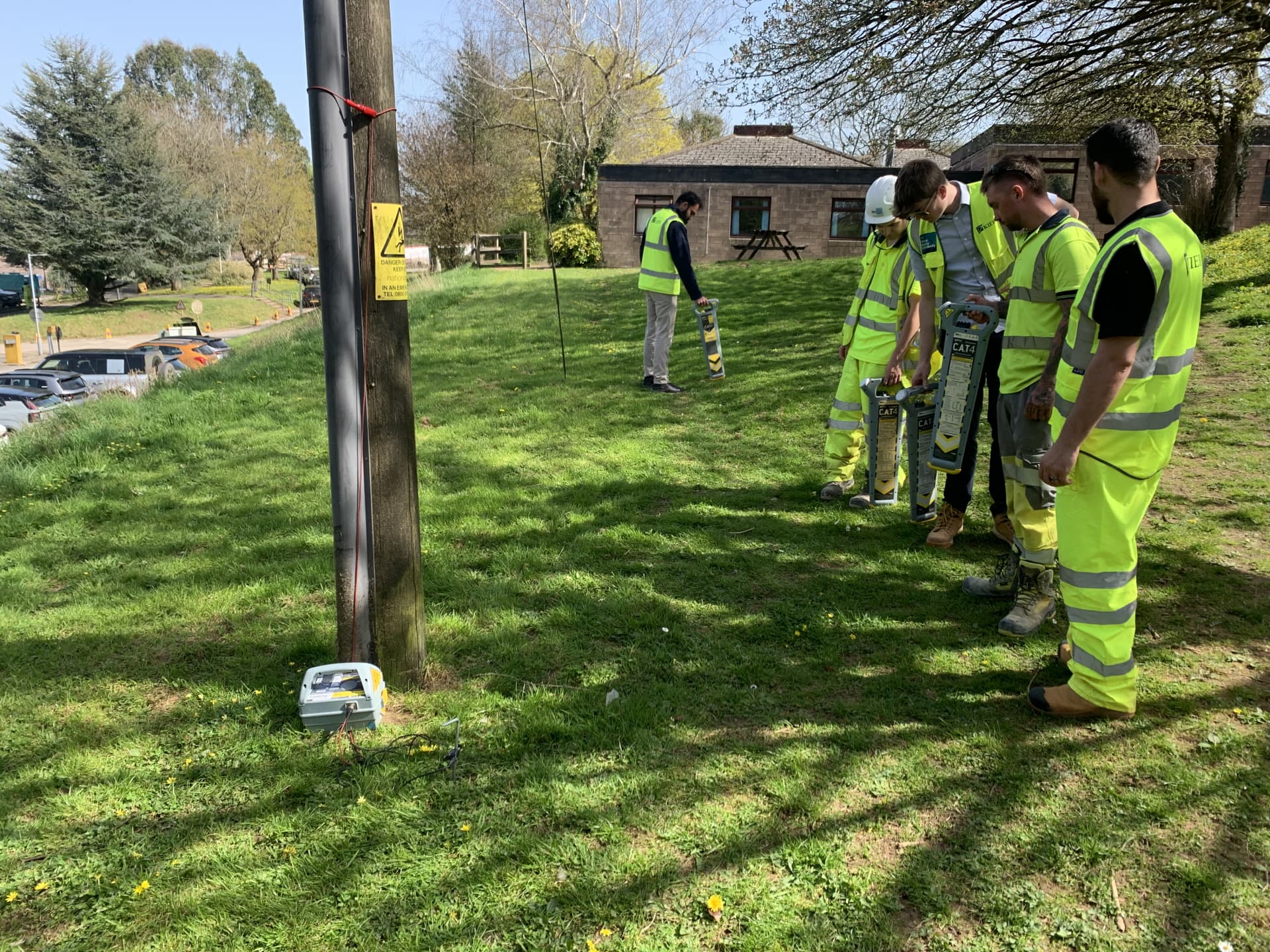
QTS Split Day 1
Classroom and practical · Day 2 at least three months later
This agenda covers
Day 1 of the split Super User course built for QTS: a full classroom grounding, then a full locating practical with a strong Genny-first emphasis. Day 2 follows at least three months later, once delegates have put it to work.
Duration
One day
09:00 to about 15:00
Group size
Max 8
Per trainer
Delivery
On-site
Built for QTS
Day 2
3 months on
At the earliest
Accredited & approved by


The split course
Two training and assessment days, at least three months apart
Day 1 is classroom and practical training. Delegates then apply it at work for at least three months, and return for Day 2: a refresher, any corrective action, and the knowledge-based and practical assessments. Each day is its own course, so it is booked, delivered and closed on its own.
Course objectives
- ✓Improve operatives' awareness of how to avoid damaging buried utilities, and operate cable locators to locate and subsequently avoid them
- ✓Pass the knowledge-based assessment in utility location and avoidance
- ✓Pass the practical assessment in utility location and avoidance
- ✓Apply the knowledge in the work environment between the two days, then return for a refresher and any corrective action
Day 1 · in the classroom
Classroom
The why behind the kit: the legislation and responsibilities, how utility networks are built, reading the plans, the physics of detection, and locating in the rail environment.
Why we locate: the risks and HSG47
The health, safety and financial implications of striking a buried service; how to comply with HSG47 (Avoiding Danger from Underground Services) and work to a safe system of work; other national legislation and company policy documentation; and the consequences of utility strikes.
Legislation and guidance
The legislation and guidance that applies, and the differences between them.
Client and designer responsibilities
Client and designer responsibilities under HSG47.
Overview of utility networks
How electricity, gas, water and communications reach our homes and businesses, and the different cable and pipe types, materials and connectivity involved.
Buried service plans (STATS and PAS128)
Interpreting and understanding the different types of service plan, including their inaccuracies and limitations.
Calibration and equipment checks
Calibration requirements, correct storage, and functional checks.
Electromagnetic theory and myth-busting
How a pipe and cable locator works, the theory and its limitations, tips and tricks, and a session on what the equipment can and cannot locate.
Controls and operation
Correct use of the cable locator and signal transmitter in all modes, with strong emphasis on transmitter (Genny) use.
Signal interpretation
Interpreting the signal, and locating service joints and changes of direction and depth.
Rail-specific survey techniques
Survey techniques for the rail environment, and the interference it brings.
Signal distortion
Signal distortion and its effects on location accuracy.
Transmitter techniques
The benefits and applications of dual frequency; using the Genny to locate small or non-earthed cables using capacitance; effective earthing and earth positioning; blind induction search and effective nulling of services.
Data logging (optional)
Recording and reviewing locator data.
Day 1 · on the ground
Practical
Everything from the classroom put to work on a real survey, leading with the Genny.
- Use service plans and existing site information to establish the indicated routes of buried mains and services, and learn the importance of site visual checks before any work begins (plans provided by the client)
- Correct use of the equipment in all modes, confirming and locating buried mains and services from the plans and previous visual inspection, testing and ensuring the equipment is in satisfactory operating condition
- Use the equipment correctly in all modes, and understand the benefits of always using the cable locator and signal transmitter combination, including dual frequency where applicable
- Apply capacitance techniques
- Effectively locate "problem" services such as street lighting and small service and comms cables
- Understand the effect of repositioning the Genny earth
- Conduct a utility survey starting with the Genny
Certificates
Two routes, chosen per booking
The course is the same on both routes: the certificate chosen for the booking decides which one it is, and both days are booked on the same route.
Route one
Sygma Certified
The in-house route, with Sygma's own certificate.
Route two
ProQual Level 2 Award
Delegates are registered for the ProQual Level 2 Award in Utility Avoidance on Day 1: the ProQual registration fee, £35 per person, is charged once, with this day. They receive the in-house Cat and Genny certificate to use until Day 2.
On the day
What the day needs
Sygma bring the trainer and the expertise. The host provides:
- ✓STATS plans (buried service drawings) appropriate to the site MUST be available for the practical work. If none exist, Sygma can supply them for a cost agreed before the course is booked.
- ✓Each operative needs the cable location equipment they are being trained on. Sygma carry a stock of equipment but cannot guarantee it is the same model delegates use; Sygma can supply it for a cost agreed before booking.
- ✓A meeting or conference room suitable for up to 8 people, with appropriate welfare facilities.
- ✓Operatives MUST have appropriate PPE to comply with national and company health and safety requirements.
- ✓A suitable site with buried metallic utilities near to the meeting or conference room.
Course timings. Timings remain fluid, with a suggested start of 09:00 and a finish around 15:00, with appropriate breaks.
Then
Day 2, at least three months later
The review, the assessments and the further practical.