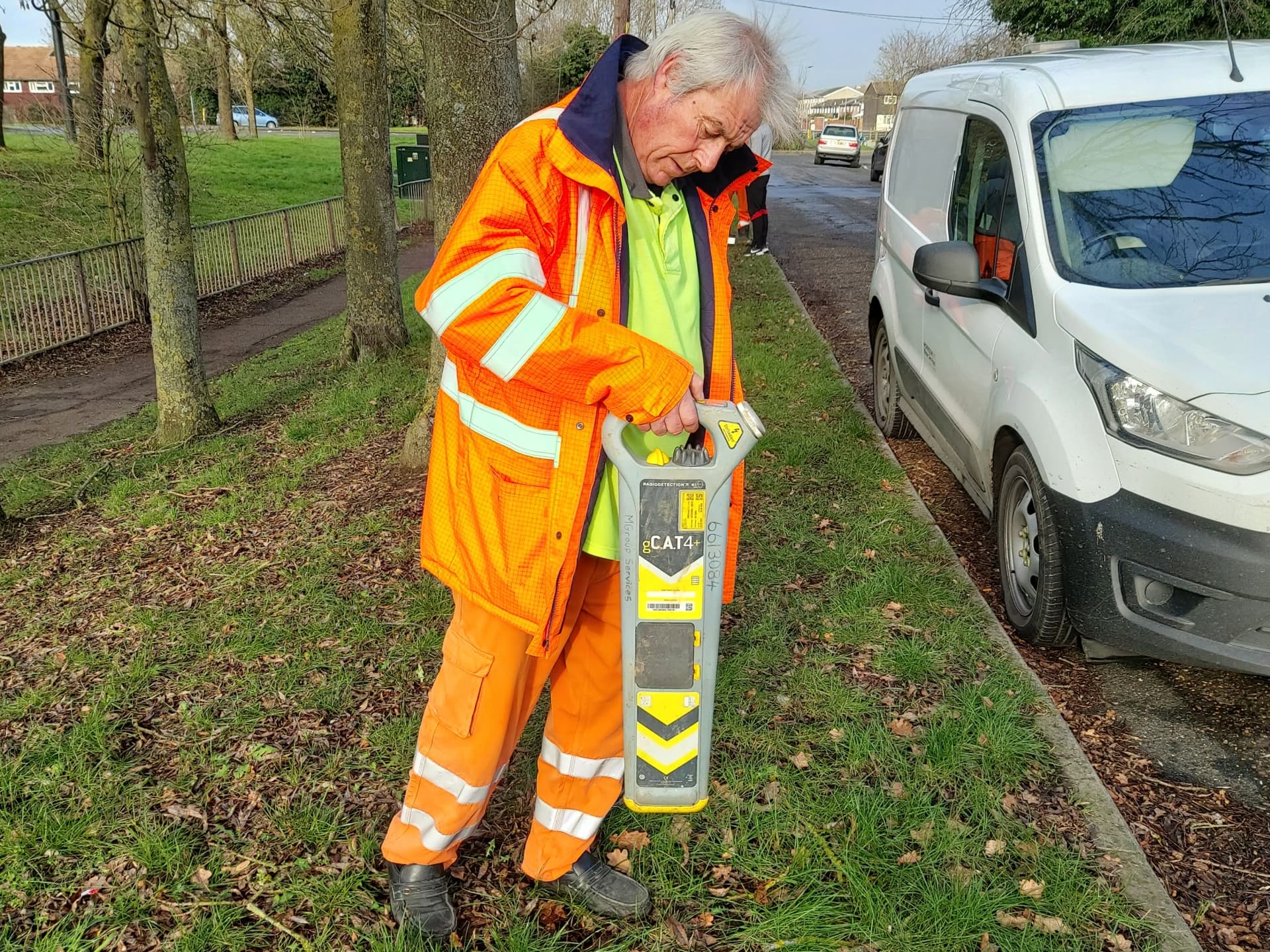
What This Video Covers
This video is aimed at CAT and Genny operators — the people on the ground using this kit day to day. It is particularly relevant for anyone who has completed EUSR CAT 1 training or a one-day cable avoidance course and wants to understand the methodology behind the equipment, not just how to switch it on. It challenges the standard sequence most operators are trained in: Power, then Radio, then Genny. It argues that sequence is the wrong way round, explains why the industry already knows this but has not caught up with it in practice, and sets out the case for putting the Genny first every time.
The Sequence Everyone Is Taught
Ask most trained CAT and Genny operators how they start an underground utility location survey and you will get the same answer. Power mode first, then Radio, then the Genny if nothing has shown up. It is the order they were taught. It is often the order written into on-site competency documents and assessment checklists. And across the industry, companies acknowledge they want to increase Genny usage and reduce strikes.
There is a contradiction in all of that. If increased Genny usage is the goal, and if it is widely accepted that many utility strikes could have been avoided with a transmitter, then why is the transmitter being left until last?
What the Manufacturer Manuals Say
The evidence for the Genny being the most effective tool does not come from Sygma. It comes from the manufacturers themselves. User guides state that power and radio signals may not be present, and advise using a Genny whenever searching for pipes. Instruction manuals describe using a Genny as the most reliable way to detect a pipe or cable. The RadioDetection ABC book makes the point clearly: despite passive signals existing, the best signal to trace is an active signal that has been deliberately applied.
A Leica blog post suggests that up to 60% of buried utilities could be missed when detecting in passive modes only. In practice, based on Sygma's CAT and Genny training data, that figure may be closer to 70 or 80%. The C-Scope manual puts it this way: most buried metallic services not found in Radio mode should be detected using a generator. These are not fringe opinions. They are in the documentation that comes with the equipment.
The Logic Problem with Passive First
The most common defence of the Power, Radio, Genny sequence is this: we use passive modes first, and if we do not find anything, then we use the Genny. That statement contains its own contradiction. It admits the Genny will find what the passive modes missed. The logical question is why not just use it first.
Think of it this way. You walk into a completely dark room. You spend five minutes fumbling around trying to make sense of what is in there. Then you switch the light on. Nobody would do it that way. They would switch the light on first. That is exactly what Genny First means.
The same logic applies to an initial sweep. If that sweep finds nothing, you still need the Genny. If it finds something, you still need the Genny to trace it properly. Both outcomes lead to the same place. So what is the initial sweep actually achieving?
What About Avoidance Mode?
Newer locators include an avoidance or all-scan mode that appears to scan in Genny, Power, and Radio simultaneously. Some workflows recommend an initial sweep in avoidance mode before moving into detailed scans. The technical specification for the CAT4 shows the sensitivity in avoidance mode is the same as in the individual modes. It will not detect anything that the individual modes could not detect. And because detailed individual scans are still required regardless, the case for an initial avoidance sweep is not straightforward. Starting with the Genny and doing Power and Radio at the end is more efficient and harder to shortcut under time pressure.
Time Pressure and the Genny That Never Gets Used
On a real site, under real time pressure, the step that goes last is the step that gets skipped. If the Genny is the last thing on the list, it is the most vulnerable to being dropped when the job feels routine. Sygma's CAT and Genny training data consistently shows a significant increase in Genny usage among operatives trained in the Genny First method. The approach itself is not technically difficult. The training is about making it the first instinct rather than a fallback.
Looking at the Data Differently
Many companies measure Genny usage through pie charts from CAT data downloads, looking for roughly equal use across modes. But if 60% or more of buried utilities can only be found with the Genny, equal usage across modes is not actually the right target. More importantly, pie charts do not show which mode was used first. Drilling into the raw data to see how surveys actually start gives a much more useful picture of whether operators are working the way they have been trained, or reverting to passive first once they are back on site.
Also in the Knowledge Hub
Ready to train your team in the Genny First approach? Sygma's CAT and Genny training covers the full methodology, connection techniques, data analysis, and site application — delivered on-site, UK-wide.
View the CAT and Genny Course