
The certificate is for a machine called the Inspector 07
The brochure says FCC, IC and EU/CE approved. Two of those three can be looked up by anybody. I looked them up, then read the laboratory report underneath them, and the name on the front of it is not the AML Pro.
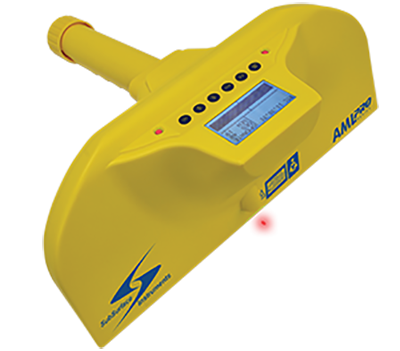
The AML Pro is sold as FCC, IC and EU/CE approved. That line does a lot of reassuring, and two thirds of it is genuinely checkable. So I checked it.
Both the FCC grant and the Canadian one trace back to a single laboratory report from February 2012. The first page of that report says the testing was performed on the Inspector 07. The model field says Inspector 07. The field for related grants says None.
The Inspector 07 is an earlier product, announced in 2008, sold on roughly thirteen feet, and described at launch as explicitly not ground penetrating radar. The machine being sold today is sold on twenty feet, and the seller’s own guide calls its waves ground penetrating, twice.
1Three approvals, and only two of them can be checked
The claim appears on the cover of the product guide published by the GB and Ireland channel partner, and again inside it.
“FCC, IC & EU/CE Approved”
Those three are not equivalent, and the difference matters more than it looks. The FCC runs a public database. Canada’s ISED runs a public Radio Equipment List. Both can be searched by anyone in about a minute.
CE is different. It is a self-declaration regime, and so is UKCA. There is no register of declarations anywhere in the world, by design. So of the three approvals in that line, the two that can be verified are verifiable, and the one that cannot be verified is the one being asserted for the European market.
To be clear about one thing that often gets argued badly: the absence of a UKCA mark is not a gap. Great Britain accepts CE marking indefinitely, so a CE-only route is perfectly legitimate. Anyone telling you otherwise is wrong.
Two of the three approvals are publicly checkable. The third is not checkable by anybody, anywhere, and that is how the regime is built.
2What the two checkable ones actually say
SubSurface Instruments, Inc. of De Pere, Wisconsin holds grantee code A47. Their record contains exactly one FCC ID.
| Register | Identifier | Date | What it says |
|---|---|---|---|
| FCC, United States | A47-AML | Applied 16 Mar 2012 | Purpose: Underground Material Locator. Type: Original Equipment. |
| ISED, Canada | 10049A-AML | Approved 27 Mar 2012 | Equipment Description: Radar Transmitter. Low-Power Device, 2400 to 2483.5 MHz. |
Both were certified by Intertek Testing Services. The Canadian entry carries a footnote worth reading, because it is the register telling you the paperwork has aged.
“This product was certified to a previous issue of the standard. A new issue is available.”Footnote on the Canadian Radio Equipment List entry
There is no later grant. Whatever the AML Pro is today, its radio certification is the 2012 one, and there is only one of it.
One FCC ID, one Canadian certificate, both from March 2012, both from the same laboratory, and nothing since.
3The name on the test report
A certification grant is a short document. The substance sits in the laboratory report underneath it, and that report is a public exhibit. It runs to 22 pages. I read it page by page, and the surprise is on page one.
“Testing performed on the Inspector 07”
It is not a one-off slip on a cover sheet. Page three sets it out in fields.
- Model: Inspector 07
- Type of EUT: Radar Transmitter
- Related Submittal(s) Grants: None
- Sample submitted: 30 September 2011
- Testing completed: 5 October 2011
Page four adds the power arrangement: an integral factory-installed antenna, and a transmitter running on an internal battery, four type C cells. The current AML Pro manual describes a rechargeable 9 volt lithium battery system. Those are not the same machine’s power supply.
What this does and does not establish. It does not establish that the AML Pro is uncertified. Certifying a product under an earlier model’s test is sometimes entirely proper, if the radio parts are unchanged. What it establishes is narrower and still worth knowing: the approvals line on a 2026 brochure rests on a 2012 test of a machine called something else, with the related-grants field reading None.
The report behind both certificates names the Inspector 07 four times and records no related grants.
4What the Inspector 07 was sold as in 2008
So what is an Inspector 07? It is an earlier SubSurface Instruments product, announced in a trade magazine in November 2008. The announcement is still findable, and two lines of it are worth putting next to today’s marketing.
| Inspector 07, 2008 | AML Pro, current | |
|---|---|---|
| Depth claimed | Approximately 13 feet | On average up to 20 feet |
| Is it radar? | “the technology used is not ground penetrating radar” | Seller’s guide calls the waves ground penetrating, twice |
| Power supply | Four type C cells, per the test report | Rechargeable 9 volt lithium system, per the manual |
The depth went up by seven feet. The description of the physics reversed. And the certificate underneath both of them is the same single 2012 document.
The same certification now sits under a deeper claim and the opposite description of the technology.
5The word the certificate uses
There is one more thing in those registers that is hard to unsee. The Canadian entry, and the laboratory report, both describe the equipment in the same two words.
Radar Transmitter
Set that beside the 2008 launch line saying the technology is not ground penetrating radar, and beside the seller’s current guide describing 2.45 GHz ground penetrating radio waves that locate PVC pipes. Three descriptions, one machine, and they do not agree with one another.
Why it matters in Great Britain is that Ofcom treats ground probing radar as licensable under OfW350, while radio determination equipment is licence exempt. Which box this device sits in is therefore a real question rather than a pedantic one.
And here is the counterweight, which has to travel with that point. OfW350’s technical criteria describe devices employing wide-band pulse techniques. The AML uses continuous-wave phase comparison, not pulses. So the manufacturer and the seller have a genuine argument that it falls outside ground probing radar altogether and inside licence-exempt radio determination. I think that argument is reasonable. It is exactly why this is a question for the regulator and never an assertion by me.
The certificate says Radar Transmitter, the 2008 launch said not radar, the current guide says ground penetrating. Which regime applies is undetermined.
6The third approval, and why nobody can check it
That leaves EU/CE, the one that cannot be looked up. It does not follow that it is absent. It follows only that you have to ask for it, and the law is on the buyer’s side about that.
The Radio Equipment Regulations 2017 require a declaration of conformity, or a simplified one carrying a web address for the full text, to accompany every single unit. They also put a duty on whoever sells it here to have verified that before making it available.
“a manufacturer must ensure that each item of radio equipment is accompanied by either a copy of the EU declaration of conformity or a simplified EU declaration of conformity”
Where I looked for it, and did not find it:
- The 32 page operator’s manual. No CE mark, no declaration, no notified body, no EN 300 440.
- All 26 pages of the manufacturer’s page sitemap. Nothing about conformity, declarations or CE.
- The seller’s downloads page, 23 PDFs covering every product line they carry. Zero declarations of conformity, for anything.
If you own one of these, the practical move is simple and it costs you an email: ask your seller for the EU declaration of conformity, by name. They are required to have verified it exists. It should arrive.
Not published anywhere I can find, which is not the same as not existing. Ask for it, because it is meant to come in the box.
7What I am not saying
I am not saying this device is unlawful to sell or unlawful to use. Nothing I have found establishes that, and anyone quoting this page to claim otherwise has gone further than the evidence goes.
I am not saying it is uncertified. It is certified, twice, and I have linked what those certificates say.
I am not saying the CE declaration does not exist. Self-declaration means there is no way to tell from the outside, and that cuts both ways.
What I am saying is narrow, and it is four checkable things.
- The only radio certification is from March 2012 and there has been no later grant.
- The laboratory report behind it names the model as the Inspector 07 and records related grants as None.
- The Inspector 07 was launched on 13 feet and described as not ground penetrating radar; the current machine is sold on 20 feet with its waves called ground penetrating.
- The one approval a buyer cannot check is the one asserted for the European market.
Ask for the declaration of conformity. It is meant to be in the box.
8Questions people ask
Is the AML Pro FCC approved?
Yes. The FCC ID is A47-AML, applied for on 16 March 2012 by SubSurface Instruments, Inc. of De Pere, Wisconsin, with the product purpose given as Underground Material Locator. It is the only FCC ID in the company's entire record, and no later grant for the AML Pro exists.
What model was actually tested for the AML Pro's FCC certification?
The Intertek test report behind the grant, report 100481024MIN-006 signed 23 February 2012, states on its first page that testing was performed on the Inspector 07. The model is given as Inspector 07 on page three, where the field for related submittal grants reads None. The samples were submitted on 30 September 2011 and testing was completed on 5 October 2011.
What is the Inspector 07?
The Inspector 07 is an earlier SubSurface Instruments product announced in 2008. A November 2008 trade announcement described it as locating non-metallic mains to depths of approximately 13 feet and stated that the technology used is not ground penetrating radar. The current AML Pro marketing claims signal penetration of up to 20 feet.
Is the AML Pro CE marked?
The product guide published by the GB and Ireland channel partner states FCC, IC and EU/CE Approved. CE and UKCA are self-declaration regimes with no public register of declarations anywhere, so unlike the FCC and IC claims the CE claim cannot be verified by a buyer or by anyone else from outside the company. The absence of a UKCA mark is not itself a gap, because Great Britain accepts CE marking indefinitely.
Does the AML Pro need an Ofcom licence as ground penetrating radar?
That is not determined and should not be asserted either way. Ofcom's OfW350 requires a licence for ground probing radar, and the certification record describes the equipment as a Radar Transmitter while the seller's guide twice calls its waves ground penetrating. Against that, OfW350's technical criteria describe devices employing wide-band pulse techniques, and the AML uses continuous-wave phase comparison rather than pulses, so there is a real argument that it falls outside ground probing radar and inside licence-exempt radio determination. It is a question for the regulator.
This piece is only about the approvals line. The physics, the depth claims and the market test are elsewhere: the AML Pro in five minutes, the transmit power that is not published, the patent that lapsed in 2023, or the full investigation.